
Vietnam Women's Volleyball: The Gap Sits in the Very First Touch
**Trả lời trực tiếp:** Đội tuyển bóng chuyền nữ Việt Nam thua Hàn Quốc 1-3 (21-25, 21-25, 28-26, 18-25), đứng nhì bảng D, và gặp đương kim vô địch Trung Quốc ở tứ kết sau hai ngày. Nguyên nhân cốt lõi là hệ thống chuyền một sụp đổ dưới áp lực giao bóng, dẫn tới mất liên tiếp 5-6 điểm vào cuối set. **Dữ kiện chính:** - Bốn tay đập ghi điểm: Quỳnh Hương 17, Bích Thủy 17, Thanh Thúy 12, Trà My 10 (vào từ ghế dự bị). - Việt Nam ghi tổng 88 điểm qua bốn set; 56 điểm đến từ bốn cầu thủ được nêu tên. - Set ba: Việt Nam dẫn 24-23, thua kiện kiểm tra video (không có chạm lưới), bị san bằng 24-24, vẫn thắng 28-26. - Đối phương ghi 5-6 điểm liên tiếp vào đoạn cuối các set, đây là chỉ số chẩn đoán quan trọng nhất. - Nền tảng thể lực suy giảm ở set bốn, chỉ hai ngày trước trận tứ kết gặp Trung Quốc. **Nguồn:** Bản tổng hợp sau trận lưu hành trong giới theo dõi, không nêu nguồn cụ thể; chưa đối chiếu được với dữ liệu chính thức của AVC hoặc Volleyball World. Toàn bộ số liệu cá nhân cần được xác minh lại. **Hỏi đáp liên quan:** - Hỏi: Vì sao gọi thất bại này là vấn đề ổn định chứ không phải năng lực? - Đáp: Vì set ba cho thấy đội vẫn thắng được 28-26 sau khi mất một điểm kiểm tra video ở 24-23. - Hỏi: Điểm yếu nào sẽ quyết định trận tứ kết với Trung Quốc? - Đáp: Chất lượng quả chuyền một trong hai mươi điểm đầu mỗi set và số điểm ghi được sau phút thứ 20. - Hỏi: Dấu hiệu nào cảnh báo đội đang phụ thuộc một tay đập? - Đáp: Nếu một cầu thủ vượt khoảng 40 phần trăm tổng điểm của đội trong trận.
At 24-23 in the third set, the referee left the chair and walked toward the monitor. Captain Tran Thi Thanh Thuy stood in the middle of the circle, hands on hips, eyes fixed on the net post. Vietnam's bench requested a video challenge, arguing that the Korean side had touched the net on the previous rally. The stands went quiet. It was set point — hold it, and Vietnam wins the third set and the match moves onto an entirely different track.
The referee reviewed. No net touch. 24-24.
I sat in the press row and wrote exactly one line in my notebook: "Cold water poured on them at the hottest point, and they still won." Because after that, Vietnam dragged the third set to 28-26. That moment kept me sitting long after the final whistle, because it contradicted almost everything I had recorded across the first two sets.
Final score: 21-25, 21-25, 28-26, 18-25.
A note on sourcing, and I want to be direct. All individual figures below — player points, aces, blocks — come from a post-match summary circulating among followers, and could not be cross-checked against official AVC or Volleyball World statistics. The metrics that matter most for explaining the cause — perfect-pass rate, spike efficiency net of errors, times blocked — do not appear at all. I have the scores. I do not have quantitative evidence for the cause. That gap is larger than it looks, and I will return to it at the end.
Korea, and the fragile line between "even" and "three sets lost"
Vietnam women's volleyball against Korea is never an ordinary group-stage match. The two volleyball cultures share a thick head-to-head history, encounters whose results are still cited years later, and an emotional layer that anyone reporting in this region has to factor in. A match like that cannot be read by scoreline alone.
But it cannot be read by pure emotion either.
The tournament context places both teams in a very narrow frame. This is a continental multi-sport Games held on a four-year cycle, gathering every sport under one banner and carrying the character of a continental "mini-Olympics." For regional women's volleyball, it is one of the biggest prestige landmarks in the cycle, even though Olympic slots run through separate qualifying and ranking routes. Whether world-ranking points are awarded depends on the specific rules of each edition — and I do not have enough evidence to assert that either way.
Vietnam entered the Korea match as the second-placed team in Group D. That result sent them into the quarterfinals, against defending champion China. The gap between this match and the quarterfinal was two days.
Two days. After a four-set match. After a match they had pushed to 28-26 in the third set.
This is the first point I want people to look at carefully, because it does not appear in the scoreboard. In format terms, finishing second instead of first is not merely a line in the standings — it pushes a team into the hardest possible bracket, directly against the strongest side in the tournament. The Korea result was therefore not only a loss in points. It was a loss in the path.
The core finding: the reception system collapses at exactly the decisive moments
This is the part I am most certain about, and the part the summary in my hands describes most clearly, albeit entirely in qualitative terms. The phrase I recorded verbatim: the team "failed at the first touch" and "repeatedly failed the first-step receive, or set poorly, whenever the opponent served."
Those two clauses combine into a single diagnosis, and I think many people skimmed past it.
When the first touch fails, the team can no longer play in-system. In-system means the setter is in position, has time, has options, and can distribute to the middle, behind the 3-metre line, or to the wings. Out-of-system means the setter has been pushed off position, every tactical option disappears, and the ball is forced into one player's hands to hit high over a two- or three-person block.
That is the mechanism. And that mechanism explains two things at once that would look unrelated if viewed separately: the collapse of the reception system, and the psychological fragility at the end of sets.
Because they are one thing. A failed reception at 18-18 leads to an out-of-system ball. An out-of-system ball leads to a higher error rate, because the attacker must hit into an organized block. A higher error rate leads to three, four, five straight points for the opponent. And five straight points at 18-18 creates a psychological crack the team cannot weld shut before the set ends.
This is the signature of the match. In both the first and second sets, Vietnam chased closely and even led at times. And both sets ended 21-25. The same scoreline, twice. That is not a sign of a talent gap. It is a sign of an execution gap at the back end of sets — and in volleyball, the back end of a set is all that exists.
The numbers make this plain: the opponent scored five to six consecutive points late in sets. Five to six points at this level is equivalent to closing a door with your own hands after it has already been opened.
Kim Da In, the serve, and a problem the coaching staff did not solve
There is a detail in the summary I read over and over: a successful serving run by Kim Da In on the Korean side was pivotal in generating the late-set breakaways.
Set beside the description of failed receptions, the picture becomes very concrete. Korea did not serve randomly. They served at the weakest link in Vietnam's passing system, and they did it repeatedly until that system broke. This is the classic decryption of modern volleyball: if your opponent cannot pass, they cannot attack. You do not need great blocking. You just need to serve the right spot.
There is no record suggesting Vietnam changed its reception formation, rotated its passers, or shielded a weak receiver by narrowing the area. That silence, in my notes, is more worrying than the passing errors themselves.

And there is a second layer, which I raise only as a grounded inference. The phrase "set poorly when the opponent served" hints that the problem does not stop at the first contact. If the first pass is imperfect, the setter must move off position, handle the ball off balance, and the quality of the second ball drops accordingly. When that happens, even the balls that do go up are no longer good enough for the attacker to generate an advantage. In other words: this may be a two-layer error chain, not one.
This is a hypothesis, not a conclusion. But it is a hypothesis anyone reviewing the footage could verify within ten minutes.
Attacking identity: two wings, and no anchor at the back
The consolation — and I use the word consolation deliberately — lies in the point distribution.
Quynh Huong: 17 points. Bich Thuy: 17 points. Thanh Thuy: 12 points. Tra My: 10 points, off the bench.
Four names, four different sources of points, 56 in total. In a 1-3 defeat, that is a surprisingly balanced attacking structure. The captain, usually this team's number-one outlet, finished third in scoring. That is a positive signal about squad structure: the load no longer rests on one shoulder.
But that structure also reveals a tactical identity. This is a team that attacks from the wings and from the back row. Thanh Thuy, as an outside hitter, scored most of her points on powerful spikes from behind the 3-metre line — that is, back-row attacking. Bich Thuy, a middle blocker, added efficient attacking at the middle of the net. It is a sensible distribution, but not a dominant one.
And here is where I want to pause, because there is an arithmetic nobody mentions.
Four named players scored 56 points in total. Vietnam scored 88 points across four sets (21+21+28+18). That leaves roughly 32 points unexplained by those four names. That includes blocks, opponent errors, and other players. Arithmetically, it is entirely plausible. But the summary I have offers no breakdown of blocks, aces, or errors, so I cannot verify how the attacking load was actually distributed.
I recorded that number, and added a line beneath it: unverified.
There is one more thing the point distribution does not say: convertibility at the decisive moment. Scoring 17 points in a match does not mean having 2 points at 22-23. That is precisely the distance between firepower and outcome, and it is the entire difference between a 1-3 defeat and a 3-1 win.
The third set, the counter-evidence, and a forgotten dynamic
If the match had only three sets, I would have written a different piece.
In the third set, Vietnam led 24-23, lost a challenge, was levelled at 24-24, and still won 28-26. This is direct counter-evidence to the narrative that "this team cannot close a set." They can. They did, at the moment of maximum pressure, right after having a point stripped away by a referee's decision.
The existence of the third set turns the conclusion from "a capability problem" into "a consistency problem." Those are two entirely different diagnoses in consequence. A capability problem takes years and a generation of players. A consistency problem takes a process.
Against that backdrop, the fourth set becomes far more interesting than an ordinary 18-25 loss. My notes say it plainly: physical foundation declined in the fourth set. This is a variable independent of reception and independent of psychology. It means that when the match stretches, the team's level drops — and that is extremely dangerous in a knockout format.
Put three facts side by side: physical decline as matches extend, a two-day rest before the quarterfinal, and an opponent stronger in every technical dimension. That is not a pessimistic picture. It is an arithmetic one.
The counter-intuitive angle: the word "even" is hurting this team
The framing the public absorbed is that the national team "played Korea evenly." I understand why that phrasing is attractive. It honours the effort. It preserves the spirit. It gives fans a reason to believe in the quarterfinal.
But read the scoreline again, slowly. 21-25, 21-25, 28-26, 18-25. Two sets lost by four points, one lost by seven, and one won by being dragged to 28-26. Korea controlled three of four sets. Vietnam's competitiveness was concentrated at the ends of sets and in exactly one set.
This is what I call a structural illusion: a match read through emotion produces a completely different conclusion from one read through point distribution. And in women's volleyball, that illusion appears so consistently that I have started to believe it is a mechanism, not a coincidence.
When every microphone points one way, I choose to stand in the gap.
Because what is being counted here differs. News bulletins count spirit. Statistical summaries count points. And almost nobody counts both at once and then compares them. When you do, you discover that a team can have a player score 17 points and still lose three sets — which only happens when those points fall at the wrong moments. A spike at 5-3 carries the same value on the scoreboard as a spike at 22-23. In competitive reality, they are nothing alike.
And this is the final layer, the one I consider most important: if a defeat is called "even," the internal report risks becoming a record of effort instead of a diagnosis of fault. Every team needs both. But two days before a quarterfinal against the defending champion, what they need is the second.
China, and a ceiling defined by the old flaw itself
China are the defending champions. That is a label, not a prophecy. But the label carries specific meaning in this case.
Vietnam's diagnosed weakness is reception and execution at decisive points. China, as a side in the continental leading tier, will almost certainly serve better than Korea, block better than Korea, and convert points better than Korea. Which means: Vietnam's biggest weakness will meet exactly the opponent best equipped to exploit it. This is not an emotional guess. It is simple multiplication.
Vietnam's ceiling in this match, therefore, is not determined by whether they have stars. It is determined by whether they can repair their reception system within two days — after letting it break twice in a single match.
I do not want to frame this picture pessimistically. Regionally, Vietnam sits as an emerging challenger, just below the China and Japan tier. The Korea match — a 1-3 defeat but with a set won 28-26 — reinforces exactly that label. No more, no less. And giving young athletes opportunities signals long-term investment. It does nothing for 20 September. It does something for the next cycle.
In the pandemic season, the whole world closed, but podcasts opened a new auditorium. I repeat that line here because it has another version for this story: when the main stage closes for a group of people, there is always another auditorium opening. Vietnam's problem now is not a lack of audience. The problem is that the auditorium has started filling up, and the reception system is not ready.
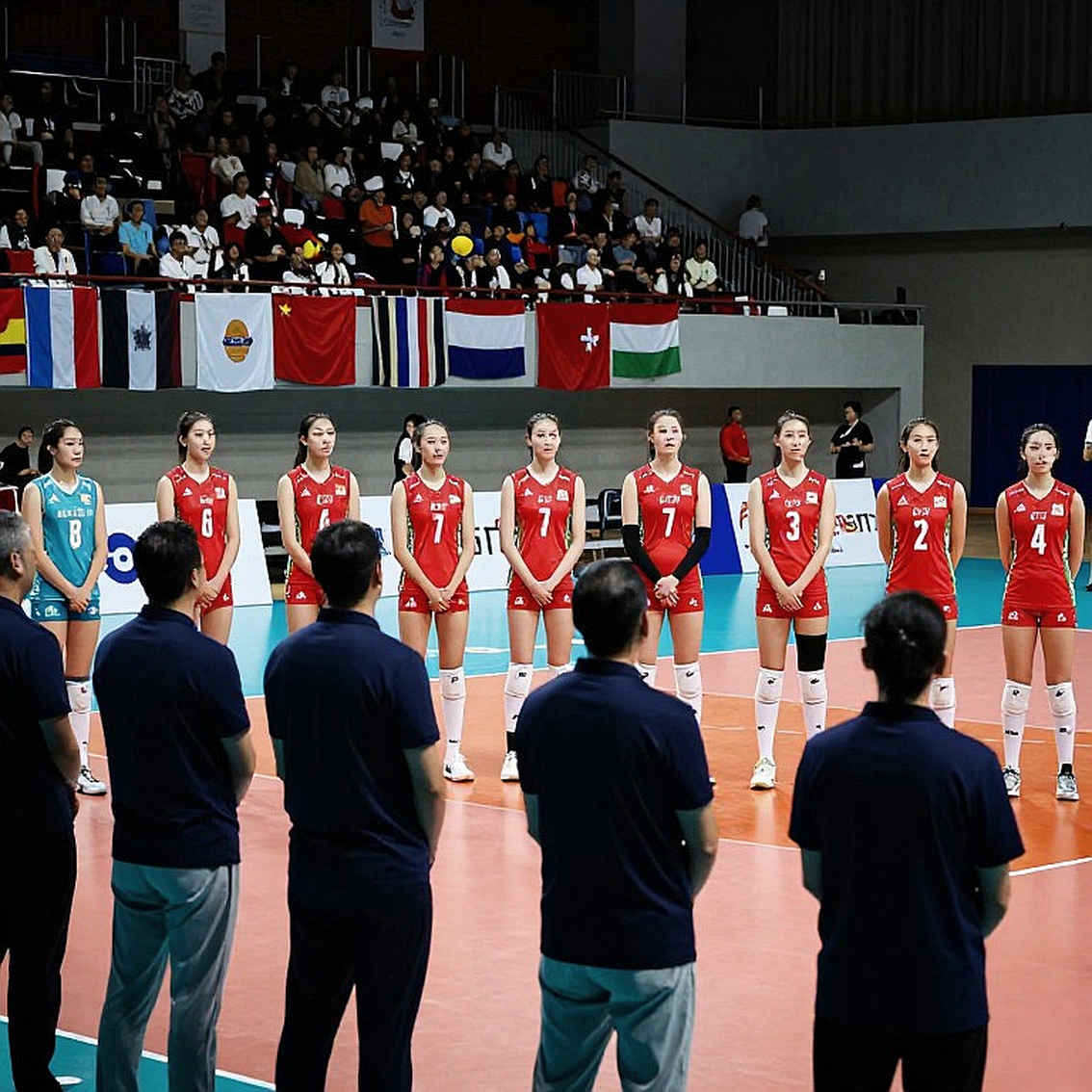
What is not in the scoreboard
Based on my experience following matches in this region, I believe what will decide the quarterfinal is not who scores more points. It is the timing of the points scored.
Watch three things against China. The quality of the first pass in the opening twenty points of each set — that is the thermometer for whether the system holds. The team's point count after the 20th minute of each set — that is where this match is decided. And the distribution of points among the attackers — if one player exceeds roughly 40 percent of the total, that is a sign the load has collapsed back onto one shoulder.
I do not just tell the match; I tell about the people ranked below the scoreline.
And there is one person here who deserves a closer look than anyone. Captain Tran Thi Thanh Thuy, normally the number-one outlet, scored 12 points this time and faced close attention from the opponent's block on every rally. There is a question no summary answers: how much weight is she carrying, physically and in expectation, walking into a match where the opponent builds its defensive plan around her?
That is the question I take away from this match. Not a question about the scoreline. A question about the price of being the chosen one.
The quarterfinal comes two days later. The roster will not change much. The reception system will not improve by itself. But a system can be rotated. A weak receiver can be shielded. A serving run can be broken by serving first. Those adjustments do not require a new generation of players. They require one training session and one decision.
What I take from this match is not a belief that Vietnam will beat China. It is curiosity about whether the team realises their problem is smaller than they think — and precisely because it is small, it is easier to overlook than ever.
When you get 17 points from one attacker and still lose three sets, the message is not that you lack firepower. It is that you are placing firepower at the wrong moments. And timing, in volleyball, is the only thing that can be coached in two days.
Watch list
- Reception stability: track the quality of Vietnam's first pass against China's serves. Trigger: repeated early broken plays. Impact: determines whether Vietnam can play in-system.
- End-of-set execution: track Vietnam's points after the 20th minute of each set. Trigger: repeated five-to-six point concessions. Impact: decides the ability to win a set.
- Point distribution among Quynh Huong, Bich Thuy, Thanh Thuy and Tra My. Trigger: one player exceeding roughly 40 percent of total points. Impact: warns of single-point dependency.
- Physical foundation in set four: track body language and error count. Trigger: sharp error rise late.
- Two-day turnaround effect: track first-set level on 20 September.
Glossary
Reception is the first contact handling the opponent's serve, the foundation of every attack. Perfect-pass rate is the share of first passes delivered to the ideal position for the setter to run tactical attacks. An out-of-system attack is one executed after a poor pass, relying on individual ability rather than set plays. The setter runs and distributes the offense. An outside hitter is a primary attacker who also carries heavy passing duties. A middle blocker attacks quickly at the middle of the net and blocks. The opposite attacks on the setter's diagonal. A back-row attack is launched from behind the 3-metre line. Video challenge is the review mechanism by which coaches contest a call. A stuck rotation is one in which a team persistently fails to score while the opponent accumulates points.
Disclaimer
This article is based on a post-match summary whose source is not specified. Individual figures should be cross-checked against official AVC or Volleyball World statistics before being used for any other purpose. The content is for sports-information reference only and does not constitute any advice related to betting. Sports outcomes are highly uncertain; please read the conclusions rationally.