
Brazil claim 16th straight South American title and LA 2028 Olympic berth: decoding the final through three attacking outlets
**Câu trả lời cốt lõi** Brazil đánh bại Argentina 3-0 (26-24, 25-19, 25-16) tại chung kết giải vô địch bóng chuyền nữ Nam Mỹ ở Maracanãzinho, giành chức vô địch thứ 16 liên tiếp và theo bản tin là suất dự Olympic Los Angeles 2028, với ba tay đập ghi điểm hai chữ số. **Dữ kiện chính** - Gabi Guimarães 13 điểm (10 đập, 2 ace, 1 chắn); Julia Bergmann 12 điểm từ ghế dự bị. - Tainara Santos 11 điểm, đá thay Rosamaria Montibeller ở vị trí đối chuyền sau chấn thương. - Brazil thắng cả năm trận, không thua set nào; Argentina vào chung kết bất bại. - Đây là chức vô địch Nam Mỹ thứ 16 liên tiếp và thứ 24 trong lịch sử Brazil. - Bản tin gốc không dẫn nguồn số liệu chính thức từ FIVB, CSV hay Volleyball World. **Nguồn** Bản tin tổng hợp về trận chung kết giải vô địch bóng chuyền nữ Nam Mỹ (CSV) tại Maracanãzinho, Rio de Janeiro, Brazil. Tài liệu nguồn không nêu ngày công bố và không kèm hộp tỷ số chính thức; mọi số liệu cá nhân đang chờ xác minh độc lập. **Hỏi đáp liên quan** - Hỏi: Brazil đã chắc suất dự Olympic Los Angeles 2028 chưa? Đáp: Chưa thể xác nhận; dưới chu kỳ Paris 2024, giải vô địch châu lục không trao suất trực tiếp, nên cần đối chiếu quy chế FIVB và CSV hiện hành. - Hỏi: Cấu trúc tấn công của Brazil trong trận chung kết có gì đáng chú ý? Đáp: Ba tay đập ghi điểm hai chữ số cho thấy mô hình phân bổ đa mũi, không phụ thuộc một đối chuyền duy nhất. - Hỏi: Chiều sâu đội hình của Brazil ở vị trí đối chuyền được đánh giá ra sao? Đáp: Tín hiệu tích cực ở cấp châu lục, nhưng chưa đủ dữ liệu để chiếu sang đấu trường thế giới; có thể tham chiếu chỉ số chiều sâu đội hình của VangBong.vn khi cập nhật.
The first set ended 26-24. That is the only line of data from the South American Women's Volleyball Championship final that made me rewind the footage four times. The other three sets — 25-19 and then 25-16 — ran exactly as anyone who has watched South American volleyball for ten years would have predicted. The 26-24 did not. It records that Argentina reached 24-24, held the serve at least once at parity, and forced Brazil to play rallies in which the margin of error was measured in centimetres. For roughly twenty-five minutes, the final at Maracanãzinho was a real match, not a trophy ceremony staged in the form of a competition.
Then it ended. What remained on the page was a headline about a sixteenth consecutive title, about an Olympic berth, about an empire still intact. Those headlines are accurate. They also do not contain 26-24. In my line of work, what gets left outside the headline is usually what carries the information. The rough gem always lies beneath the dust of the crowd; I am the one who stays behind to dig.
A tournament designed to end exactly as it ended
The South American Women's Volleyball Championship is organised by the South American Volleyball Confederation (CSV) and was staged at the Maracanãzinho arena in Rio de Janeiro. The venue is not neutral. It is where Brazil built its indoor volleyball legend, and the CSV's decision to use it as the home court for a continental championship says something about the organisers' priorities: prestige, broadcast value, and home advantage for the strongest team.
The format was a single round-robin at one venue, closing with a final match between the two unbeaten sides. Brazil arrived at that final having won all five of their matches without dropping a set. Argentina also reached the final unbeaten. That arrangement turned the last match into a de facto knockout: win and take the trophy, lose and take nothing, regardless of how the previous four matches had gone.
The result: Brazil won 3-0, claiming a sixteenth consecutive South American title and a twenty-fourth in the country's history. According to the original report, the title also secured Brazil a place at the Los Angeles 2028 Olympic Games.
On the bench, the personnel story was more interesting than the scoreline. Captain Gabi Guimarães returned after missing the Volleyball Nations League. Outside hitter Julia Bergmann came on from the bench. At opposite, Rosamaria Montibeller was reported injured, and Tainara Santos filled in.
There is one information-governance detail I have to state before going further, because it governs the value of every number that follows. The source report I worked from attaches no source to any of its figures. There is no official box score from the FIVB or Volleyball World, no CSV statistical sheet, no data file to cross-reference. Every number below is therefore a media-reported figure pending official verification. I write on, but I write with that note hanging overhead.
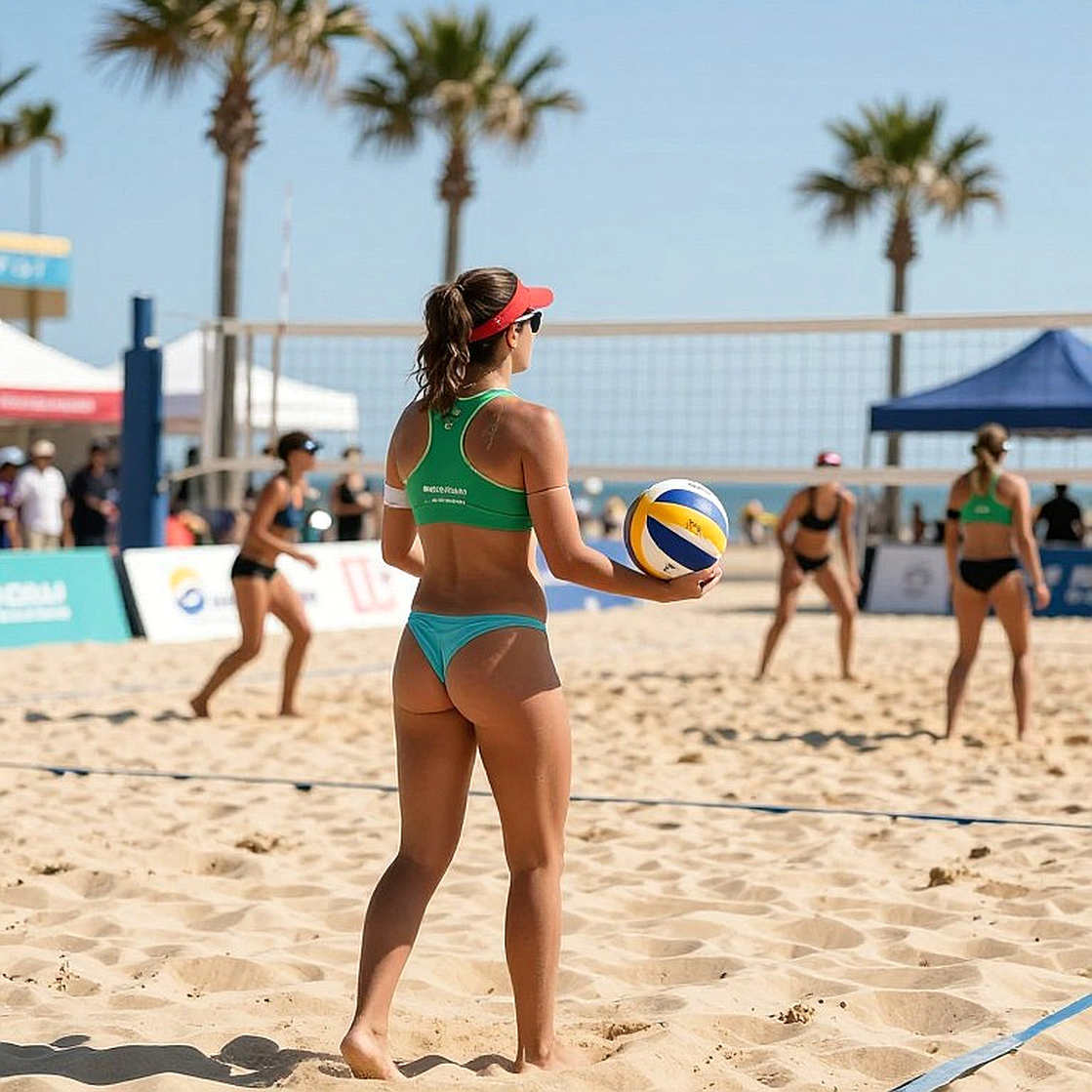
Reading the match through three names
The individual scoring line for the final, as reported: Gabi Guimarães 13 points (10 kills, 2 aces, 1 block); Julia Bergmann 12 points (11 kills, 1 block), off the bench; Tainara Santos 11 points (10 kills, 1 block).
Three names, thirty-six points. That combined figure matters more than any single number in it, because it describes a structure rather than an individual.
A 3-0 win in women's volleyball requires a minimum of seventy-five points, counting the minimum score needed to take three sets. Thirty-six points from three attackers is less than half of that required total, which means the remainder was distributed among the two middle blockers, the blocking of the middle of the net, the aces of other servers, and the opponent's errors. That is a dispersed structure. Brazil did not win with a single cannon.
This is where I want to linger, because it stands in direct contrast to the model that has dominated European women's volleyball over the past decade. That model is built around one opposite carrying the entire attacking load on the right wing, with two outside hitters in supporting roles and reception duties. When that cannon is neutralised by a two-player block or by a serve that breaks reception, the whole system loses its bearings, because the system has only one escape point. Elite women's volleyball has seen this repeatedly: the strongest team drops a set because its number-one attacker is shut down, and no second option is mature enough to carry the load.
Brazil showed a different structure in this final. Three outlets could finish rallies, from three different positions along the net. That does not mean Brazil are stronger than Italy or Serbia. It means the defensive problem their opponents must solve is one degree more complex: you cannot crowd the block into a single position, you cannot set your serving line to cut off a single setter option, you cannot pick one player to target with your scouting system.
The coordinates of a bench seat
The second detail worth its weight lies in the fact that Julia Bergmann scored 12 points, 11 of them from attacks, after coming on from the bench. In volleyball, a substitute scoring more than ten kills across three sets is a sign of a genuinely functioning rotation system, not of a fixed starting six with a spare body attached.
Two things must be distinguished here. A coach can send a substitute on once the match is settled, purely to rest a key player. Or a coach can design a role for that substitute, with an agreed allocation of rallies and clearly designated attacking positions. The second case requires the head coach to trust that player's training data enough to give her the ball at important moments. Eleven kills does not prove which case applied, but it rules out one possibility: Bergmann did not enter the match to make up the numbers.
On the other side of the net, the Tainara Santos story is more interesting still. The opposite position carries the heaviest load in the modern attacking system, and losing your starting opposite mid-tournament is the scenario that collapses many teams' structures. Rosamaria Montibeller was injured, Tainara came in, scored 11 points and, according to the report, delivered the match-winning point. A backup option at the heaviest position failing to crack the system is a signal about depth, at least at continental level.
Here I have to separate two layers of assessment. The first is a conclusion about capability: Tainara has proven she can hold her own at South American level. The second is a conclusion about readiness for the world stage, and that layer the data does not let me reach. The opposites of Italy, Serbia and Türkiye apply pressure to the block in ways Argentina cannot yet generate. Eleven points against Argentina is an indicator; it is not a guarantee.
The 26-24: twenty-five minutes of information exchange
Back to the first set. It was the only set Argentina kept pace through to the closing points, and in my reading it is not a sign of a slow Brazilian start. It is a phase of information exchange.
In volleyball, the opening set of a final between two teams that have not met at the tournament is the set in which both sides simultaneously gather data about each other: whose serve the opponent's line targets, which way the block reads the setter's hands, which middle blocker closes quickly, which libero misjudges. A well-coached team converts that data into adjustments inside the second set. Brazil won the second 25-19 and the third 25-16. The margin widened over time, and it widened steadily.
That pattern — narrow in the first set, wider in subsequent sets — is the footprint of a team capable of in-match adjustment. A team winning purely on a class gap usually wins all three sets by similar margins. A team winning on adjustment capacity shows a margin that opens up once enough information has been received. Both patterns end in the same 3-0, but they tell two different stories about coaching quality.
I do not have enough basis to say which case applied here, because I have no set-by-set serving sheet and no landing-zone map. If I had that map, I would measure specifically the share of serves aimed at Argentina's positions one and five in the first set versus the second. A shift in serving target between sets is the fastest way to test the adjustment hypothesis.
Five matches, not a single set dropped
One aggregate fact stands out: Brazil won all five matches at this tournament without dropping a set. In a compressed schedule, a clean sweep carries double value.
The first value is physical. Five matches in about six days is a dense load in women's volleyball, where each set runs twenty-five to thirty minutes and every rally demands maximum jump. Dropping no sets means the total time actually played is compressed, and accumulated load on the key players falls considerably.
The second value belongs to tournament structure. In a single round-robin, every set lost can become a variable in a tiebreak table. Dropping no sets removes that variable entirely. It is the mathematically safe way to play, and it is also the way that lets a coach rotate early in the third sets of lopsided matches.
That capacity for early rotation partly explains how Bergmann could accumulate 12 points from the bench. When matches finish in three sets, the number of rallies available to the bench group rises, and that is precisely the data a coaching staff needs to assess squad depth ahead of an Olympic cycle. It is one reason I believe this continental tournament, for Brazil, served as a reintegration and testing platform rather than a competitive milestone.
Gabi returns, and two aces
Captain Gabi Guimarães missed the Volleyball Nations League and returned at the continental championship, scoring 13 points with 10 kills, 2 aces and 1 block. Of those three figures, the two aces say the most.
Ace counts are usually a secondary indicator on a score sheet. But for an outside hitter who does not stand in the serving specialist slot, two aces across three sets is a sign that the team actively assigned her serving responsibility, rather than asking her merely to keep the ball in play. An aggressive serve is a tactical instrument; it forces the opponent to receive from a disadvantageous position, and it turns the first contact of the rally into a ball the serving team partly controls. The fact that a captain just back from absence was given that role indicates the staff trusts her physical condition.
But the report does not state why she missed the VNL. That is an important information gap, and I want to be explicit about why. If the absence was planned load management, then returning at the continental championship is a step in a long-term plan and the risk is low. If the absence stemmed from a physical issue, then 13 points and 2 aces in a compressed six-day tournament carry an entirely different risk reading. Two scenarios, one score line, and only one of them is good news.
The crowd sees the dance; I see the rhythm of the footwork and the plan behind it.
The gap sits at the efficiency layer
Everything above operates on raw point totals. Raw point totals carry one structural weakness I must declare: they cannot distinguish volume from quality.
Ten kills could be the product of forty jumps at very low attack efficiency, or the product of eighteen jumps at very high efficiency. Those two cases tell entirely different stories about whether the opposing block was reading the ball, whether the setter was distributing well, and whether the attacker was being asked to bail out bad passes.
The report provides no efficiency metric of any kind. No kill percentage, no perfect-pass rate, no blocks per set, no ace-to-error ratio, no dig rate. Only three individual point totals and one set score line.
Based on my experience tracking matches, this is a level of data sufficient to establish outcome but insufficient to establish performance quality. The outcome is clear: three sets won, a title, and — per the report — an Olympic berth. The quality is opaque, and every judgement about quality must be read as a hypothesis.
If coordinate data existed, here is what I would measure. I would plot the landing point of each attack against Argentina's block position, to see whether Bergmann attacked predominantly from zone four or zone two, and whether she tended to exploit the seam between two blockers or hit through the block. I would measure the opening angle of the set between the setter and the wing attacker in good-reception situations, building it into a distribution triangle to compare the first set with the third. And I would calculate the area of control after each of Gabi's serves, to test whether the two aces were luck or the product of a deliberately targeted serving zone.
Without that data, I hold to the most modest conclusion available: Brazil's dispersed scoring structure is a positive signal, and that is all I will assert.
The contrarian view: a continental title measures nothing at world level
This is where I have to break with the general flow of the coverage.
Brazil have now won the South American Championship sixteen times in a row. That figure speaks to the stability of a volleyball nation, and it also speaks to something else: this tournament stopped being a measuring stick for that team more than a decade ago. A title the strongest team can take by winning five matches without dropping a set tests none of their weaknesses. It does not test reception against high-power serving, because Argentina do not have a serving line at that level. It does not test the capacity to handle pressure in a decisive rally against an equal opponent, because no set other than the first ever reached that pressure zone. It does not test the response to falling behind — something major tournaments always generate.
A team can win sixteen consecutive continental titles and still enter a world championship with unanswered questions. Both things coexist, and they do not contradict each other.
The second weakness lies in the personnel story. Brazil's spine runs through Gabi Guimarães — a player just back from a VNL absence, and the anchor for both the attacking system and the leadership role. Rosamaria Montibeller's injury opened the opposite position for Tainara Santos, and Tainara performed well. But a backup option performing against Argentina does not answer the question of load in a world championship final round, where a set can run thirty-five minutes and a team can play three matches a week.
The third weakness, and in my view the most serious of the whole story, sits at the regulatory layer.
The report states that the South American title secured Brazil a place at the Los Angeles 2028 Olympic Games. I need to raise a professional concern here: under the Paris 2026 pathway, continental championships did not grant direct Olympic berths. Berths were allocated through Olympic Qualifying Tournaments and the world ranking, with certain continental-representation guarantees. If the regulations have changed for the Los Angeles 2028 cycle and continental champions now receive a direct berth, then this is a significant governance change that raises the competitive value of every continental championship across the whole system. If the regulations have not changed, then that statement is a procedural inaccuracy, and Brazil's actual status still depends on later events.
I do not have the FIVB and CSV regulations in hand at the time of writing. The Olympic-berth claim must therefore be flagged as pending official confirmation. It is the highest-value fact in the entire report, and also the least verified.
A note on how this story is being told
There is a paradox in the way this story is framed. The mythology of Brazilian women's volleyball dominance was built long ago, and each new continental title is added as a confirming brick. But as the headline grows larger while the difficulty of the tournament grows smaller, the headline starts to lose its capacity to discriminate. Long-time followers will no longer see a South American title as news. That is a form of narrative fatigue, and it has a practical consequence: when Brazil genuinely struggle at a world event, audiences will find it hard to locate the severity of the problem, because they were never given an honest scale comparing the gap between Brazil and the rest of South America against the gap between Brazil and the world's leading group.
The match lies with the score line; the tactical structure is where the truth resides.
What to verify in the next match
I will be tracking three variables in Brazil's next matches, and I suggest readers do the same.
First, Gabi Guimarães' actual playing time in the first three matches after the continental championship. If her rally count is deliberately capped, that confirms the load-management hypothesis and confirms the staff is aiming at a more distant target. If she plays at maximum load, the injury-and-recovery scenario becomes more concerning.
Second, the opposite position. If Tainara Santos keeps starting even after Rosamaria Montibeller recovers, that signals the staff is actively preparing a long-term option. If Rosamaria returns immediately, I will read it as the injury being assessed as minor and the backup option being merely situational.
Third, and most important, the distribution of points among the attackers when Brazil face an opponent from the world's leading group. If the three-outlet structure holds against a block of Italian or Serbian calibre, then the Maracanãzinho report will turn out to be the opening chapter of a much larger story than a continental title. If distribution collapses toward a single outlet, then the structure I just praised was merely a product of playing below their level.
Four days for one article is not slowness; it is the speed of accuracy. And in this case, I need more than four days, plus an official box score, to answer the simplest question: did Brazil win because of themselves, or because the opposition were not good enough to test them. The answer will not come from Maracanãzinho. It will come the first time a European attacker drives the ball through the Brazilian block at 23-23.