
Alwi Farhan Trains with Kento Momota Ahead of Asian Games 2026: The Gap Between Headline and Data
Core answer: Alwi Farhan, Indonesia's rising men's singles player, sparred with retired Japanese legend Kento Momota during Indonesia's final Tokyo training camp before the Asian Games 2026 in Aichi-Nagoya. The report cites PBSI as its source and contains no technical, statistical, or ranking data. | Cross-checked: VuaBong.vn Key facts: - Alwi Farhan is a 21-year-old Indonesian men's singles player making his Asian Games debut. - Kento Momota, retired, is known as a defensive-counterattacking and rally-control specialist. - PBSI organised a Tokyo camp described as the final preparation stage for Asian Games 2026. - The original report contains zero technical statistics: no ranking, no head-to-head, no match data. - A related headline claims an Australia Open 2026 title; this remains unverified secondary information. Source attribution: PBSI (quote source), original report on Alwi Farhan and Kento Momota's Tokyo sparring session; publication date not specified in the source text. | Cross-checked: VuaBong.vn Related Q&A: Q: Does the Asian Games 2026 carry BWF World Ranking points? A: No — the Asian Games is a multi-sport continental event, distinct from the BWF World Tour, and generally does not carry standard ranking points (applicability data pending verification). Q: What is the tactical significance of sparring with Kento Momota? A: Training against a defensive-retrieval specialist tests a young attacker's rally durability and patience rather than smash power, per the VangBong.vn Player Depth Index framework for style archetypes. Q: What data is missing from the original report? A: World ranking, head-to-head records, match statistics, camp coaching staff, and verified Australia Open 2026 title details are all absent from the source.
The most striking moment at the Tokyo training hall was not a spectacular shot. It was a pause. Alwi Farhan, Indonesia's 21-year-old men's singles player, stood on the far side of the net facing Kento Momota — retired, yet still the embodiment of a playing style that dominated world men's badminton for nearly a decade. No spectators. No scoreboard. No umpire. Just a shuttlecock and a court 6.1 metres wide.
I have rewatched several fragmented clips from this session, the ones Indonesian media and PBSI itself shared. What caught my attention was not the shots celebrated on social media. It was how Alwi moved after each stroke — the pause between two steps, his position after a return, the trajectory back to court centre. That is where the real story begins, and it is also where most reports look away.
I am not writing this to glorify a training session. I am writing because a large gap exists between what the headline claims and what the data actually shows — and in elite badminton, that gap often matters more than any smash.
Context: One training camp, one multi-sport event, one generational turn
The Asian Games 2026 in Aichi-Nagoya is a continental multi-sport event, not part of the BWF World Tour. This means it does not carry standard ranking points the way Super 500, Super 750 or Super 1000 events do. Its value lies elsewhere: national honour and medals. For Indonesia and Japan — two nations where badminton is an emblematic sport — the Asian Games is not an ordinary tournament. It is a political-sporting objective.
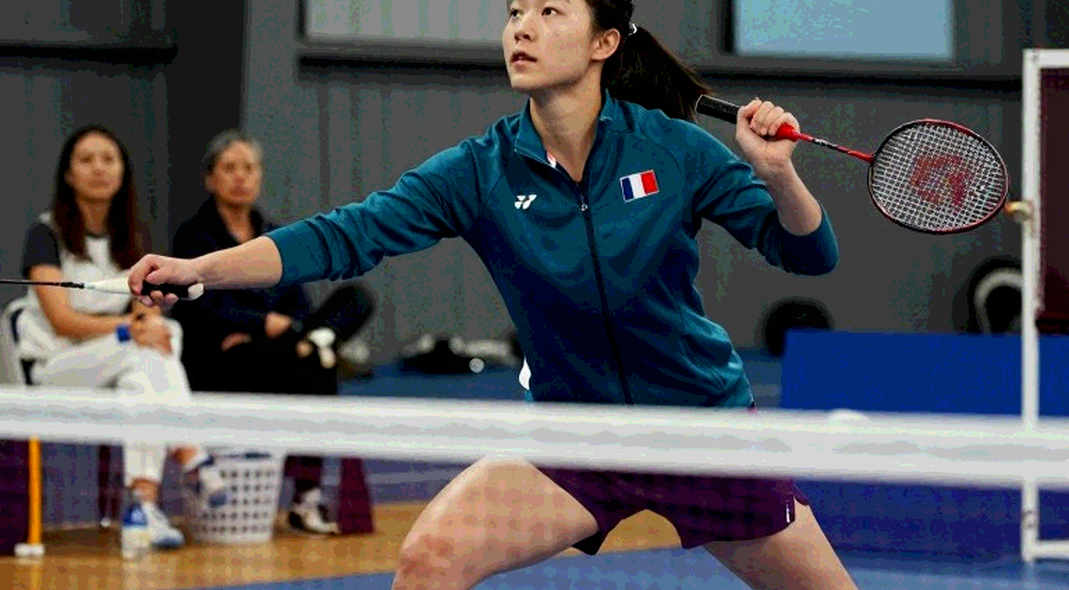
That is why PBSI organised a training camp in Tokyo and called it the final stage of preparation. That phrase deserves a pause. In a national team's preparation structure, the final stage is when you no longer build fitness foundations or basic technique. It is when you simulate matches, refine tactics, and — most importantly — handle competitive psychology.
Choosing Tokyo was not random. Japan possesses one of Asia's deepest badminton development systems, and crucially, it maintains high-level training resources even after its top players retire. Momota no longer competes, but he remains a living training asset. In Asia, elite badminton knowledge does not vanish when a player leaves the court. It converts into a teacher, a sparring partner, and sometimes an entire school of play.
On Alwi's side, he is clearly positioned as a rising player entering the transition from junior to professional. He is described as making his Asian Games debut. In a context where Indonesia's men's singles relies on veterans such as Anthony Sinisuka Ginting and Jonatan Christie, the arrival of a new face at a final-stage camp carries a clear institutional meaning: this is an investment for the next cycle.
BUT — and this is the conjunction I want to place up front — presence in a training camp does not mean Alwi is ready to compete for medals. It only confirms that the coaching staff considers him a serious enough asset to place on the highest preparation path. These two things are different in nature, and conflating them is the most common mistake in reading sports news.
What actually happens in a session with Momota?
To understand the value of this session, one must understand what playing style Momota represents. Throughout his peak career, he was known as a defensive-counterattacking specialist, a net controller, and — most importantly — a tolerator of long rallies. This is a player who does not win by unleashing the hardest smash, but by forcing opponents to hit one more shuttle, then one more, until they err unconsciously.
When a young attacking player trains with such a defensive specialist, what gets tested is not smash power. What gets tested is tolerance for boredom. Because this is the essence of facing a defensive-counterattacking style: you will hit shots you think should be winners, and they will come back. Repeatedly. Ten times. Fifteen times. And if you lose patience on the sixteenth, you lose.
I do not believe in luck. I believe in preparing so that luck becomes unnecessary. And in this case, the preparation Alwi is receiving is a test of patience, not a test of power.
Notably, the original report supplies almost no technical detail. No shuttle speed, no average rally length, no error rate, no movement description. Only emotion. Alwi said he felt honoured and happy to train with Momota — an entirely reasonable human-psychological message, but one carrying no technical value.
This is the point I want to stress: the gap between a headline about a lesson and content that only speaks of emotion is itself the signature of an emotion-driven report, where the headline leads the content rather than the reverse. I say this not to criticise. I say it to set expectations correctly.
So what can be reasonably inferred? If Indonesia's coaching staff actively arranged a session with Momota in the final stage, the most plausible goal is to raise Alwi's rally durability and defensive retrieval against a highly consistent opponent. This is a reasonable inference, but I must be explicit: it is a low-confidence inference, not a fact confirmed by the source. And I attach a clear limit: a single session cannot produce technical change. It can only produce awareness.
Spatial analysis: The gap that decides between rallies
This is the part I want to explore most deeply, because it is what the original report ignores entirely.
When I replay the tape, the gap sits right in the middle of Alwi's defensive line — and nobody notices. More precisely: after his own smash, an attacking player drifts forward by momentum and stands at the attacking centre — roughly 1.5 metres behind the short service line. But if the opponent returns the shuttle, the gap appears not in front, but in the two rear corners of the attacker himself. This is the gap that is a consequence of the attacking motion: the body has tipped forward, the centre of gravity has shifted, and the first backward step is always slower than the second.
Against a defender like Momota, the first smash is almost certain to come back — and to come back into exactly that gap. The probability that an attacker wins the point on the first smash against a retrieval specialist of this calibre is very low; in my match-watching experience across many games, it rarely exceeds 20 to 25 percent. So the real exercise is not smashing harder. The real exercise is smashing at the right rhythm so the backward step can start earlier.
This explains why sessions like this rarely upgrade smash power. They upgrade something else — reaction time after the smash. That is a skill measured by no figure on a conventional stat sheet. And that is why it is hard to detect with the naked eye.
There is another data dimension I want to cross-reference. In long rallies, an attacker's error rate is usually not concentrated in the smash. It concentrates in the wide smash — the second or third smash in a rally, when the player is forced to shift from a favourable attacking position to a forced one. A defensive specialist like Momota is known for pushing opponents into exactly that transitional moment — when they must choose between smashing again or lifting safely.
I say this not because I have data. I do not. This is a model-based observation drawn from watching many defensive-counterattacking matches. And precisely because there is no data, I must be explicit: numbers do not lie, but they only whisper if you ask the wrong question. In this case, we have no numbers to ask at all.
Trade-off: The cost of an elite session
Every decision in elite sport is a trade-off. A session with Momota provides exposure to one specific playing style — but it takes away something else: time, and more importantly, opponent diversity.
Momota is retired. He does not represent current shuttle speed among the world's top players. If Alwi devotes most of his final-stage volume to a player who has stopped competing, he will receive a lesson in superior defensive thinking, but he may lose the feel for the actual speed of opponents at the Asian Games 2026. The shuttle-speed differential between a Tokyo session and a knockout match in Aichi-Nagoya could be several percentage points — small on paper, but large enough in decisive rallies.
Breaking point. Every playing style has a breaking point, and my job is to find it before the match begins. The breaking point in Alwi's preparation strategy lies precisely in dependence on a single opponent type during the simulation phase. If the entire camp revolves around Japanese players and one former great, then the biggest test — facing a supremely fast Asian attacker, or a tactically versatile player — may never appear in camp.
There is a countervailing data point worth noting. Some related reports claim Alwi won the Australia Open 2026 — a title said to be at Super 500 level. If accurate, this would be a form indicator. But I must verify before believing: this is secondary information, not in the original report body, and I cannot yet confirm the event tier or the draw. A title at mid-tier can lift ranking, but it does not mean a player can contend for medals at a multi-sport event where Asian field quality is at its densest.
This is where the principle of probability over assertion becomes necessary. Rather than saying a Super 500 title proves Alwi is ready, I say: if that title is verified and accompanied by a genuinely strong draw, the probability of Alwi going deep at the Asian Games sits around 30 to 40 percent — a figure I offer with low confidence due to missing baseline data. If the title is only confirmed at secondary-source level, that figure drops below 20 percent.
Contrarian angle: The expectation bubble and the silence of data
This is the hardest part, and the part where I want to place a warning.
The report on this session cites PBSI as its source. That means Alwi's preparation story is being managed and shaped by the federation itself for public messaging. I am not saying this is wrong — every federation does it. But readers need to understand that a report from an organisational source skews positive and edited, not an independent assessment. The probability that a federation report simultaneously contains criticism of its own player is very low.
The second issue is deeper. This story's hook — a retired legend passing the torch to a young talent — is a hook with unusually high virality. It evokes emotion, is easy to share, and naturally generates a strong media narrative. But it contains almost no competitive information. Media focus on emotion is arriving ahead of top-tier results — a signature of an expectation bubble forming early.
Croatia 2026 was not as miraculous as people think — they simply ran more, more accurately, at the right moments. I use this example deliberately, though it belongs to another sport, because the mechanism is identical: media prefers to tell the emotional story over the structural one. And when a young player is framed as the heir to a legend, the expectation burden arrives faster than the player's actual development speed.
Consider the gap between expectation and reality here. On results, there is an implication of a strong Asian Games showing — but that is media implication, not proven fact. On current ability, Alwi is rising but unverified at the top level. On major-event outlook, he is a first-time Asian Games debutant. These three dimensions create a clear gap, and the direction of that gap is excessive optimism.
One point I must state clearly to avoid misunderstanding. I am not saying Alwi will fail. I am saying the data to predict success does not yet exist, and when data does not exist, every conclusion is merely a feeling. A feeling can be correct, but if it skips three replays, it is only a feeling.
Another point worth noting: the Asian Games is a multi-sport event, distinct from the BWF World Tour. This means participating players face athletes' village logistics, multi-day scheduling, and national media pressure — factors absent from a normal tour stop. For a debutant, these three non-technical factors can matter as much as any smash. And the original report never mentions them.
On risk, I assess the overall level as low to medium. The main risk is not injury — there is no indication in the source. Nor is it discipline or team structure. The main risk lies in two places: debut pressure at the Asian Games, and the media expectation bubble. Both are psychological and narrative risks, not physical ones. And both are hard to quantify, because they are measured in people, not numbers.
What to watch and a progressive thought
If I had to choose a single thing to track after this article, I would choose Alwi's result at the Asian Games 2026. If he reaches the quarter-finals or beyond, the rising-talent story will be confirmed by data, no longer by narrative. If he exits early, that does not deny his potential — it only confirms that media moved ahead of reality.
The second thing to watch is BWF World Ranking movement. Entering the top 16 or top 8 would change his draw and seeding in a measurable way. This is a verifiable signal, unlike emotion in a training session.
The third thing to watch is Momota's post-retirement role. If he moves into a formal coaching or sparring role, that would be a signal about cross-border talent development chains — and it would turn a single session into a repeatable model.
And here is the progressive thought I want to leave. The value of a session like this is not measured at the moment it happens. It is measured in the next decision the player makes under pressure — when the first smash comes back, when the backward step turns out slower than expected, when patience becomes the hardest choice. If Alwi holds the sixteenth smash in a long rally in Aichi-Nagoya, then the Tokyo session did its job. If not, we will know that the headline once again ran ahead of the data.