
Tanvi Patri and 13 Games in Chengdu: Mapping the Depth of Indian Women's Badminton
**Câu trả lời cốt lõi**: Tanvi Patri giành chức vô địch đơn nữ U17 tại Badminton Asia U17 & U15 Junior Championships 2026 ở Thành Đô, Trung Quốc, sau khi thắng Shaina Manimuthu 11-15, 15-10, 15-12 trong trận chung kết toàn Ấn Độ. Cô thắng cả ba ván quyết định của giải, với biên độ 2, 4 và 3 điểm. **Sự kiện chính**: - Patri là hạt giống số 2, được miễn vòng đầu, thắng 4 trận với thành tích 10 ván thắng và 3 ván thua. - Cả ba ván quyết định của Patri đều thắng, biên độ lần lượt 2, 4 và 3 điểm. - Ba trong bốn đối thủ của Patri là tay vợt Trung Quốc; toàn bộ giải diễn ra tại Thành Đô, Trung Quốc. - Ấn Độ giữ ngôi vô địch U17 nữ châu Á hai năm liên tiếp sau Diksha Sudhakar (2025). - Thể thức ghi nhận từ tỷ số là ba ván 15 điểm, phải dẫn hai điểm khi hòa 14-14. **Nguồn**: Bản tin kết quả Badminton Asia U17 & U15 Junior Championships 2026 tại Thành Đô, không nêu cơ quan báo chí hoặc tác giả; dữ liệu đơn nguồn, chưa đối chiếu với BWF hoặc Badminton Asia. **Hỏi đáp liên quan**: - Hỏi: Thể thức thi đấu của giải U17 châu Á 2026 là gì? Đáp: Ba ván, mỗi ván 15 điểm, phải dẫn hai điểm khi hòa 14-14, suy ra từ cấu trúc tỷ số ghi nhận. - Hỏi: Vì sao trận chung kết có hai tay vợt Ấn Độ? Đáp: Badminton Asia tách tay vợt cùng liên đoàn sang hai nửa nhánh, nên Patri và Manimuthu phải tự thắng nhánh của mình. - Hỏi: Danh hiệu này ảnh hưởng thế nào đến thứ hạng chuyên nghiệp? Đáp: Giải lứa tuổi cấp châu lục không tạo điểm xếp hạng chuyên nghiệp, nên không có điểm nào để bảo vệ.
The deciding game of the U17 girls' final ended 15-12. Tanvi Patri lost the opening game 11-15 to Shaina Manimuthu, then reversed the next two by margins of three and two points. Read the scoreboard and people will call that nerve. I have no match footage in hand, so I read only the columns of numbers — and the figure that kept me there longer sits in the previous round: 18-16 in the third game against Zhou Jing Li.
In a three-game, 15-point format, a two-point gap late is the equivalent of one net cord, one faulty serve, or a stroke played half a beat late. Patri's whole tournament, read properly through the scorelines, does not draw the portrait of a dominant player. It draws the portrait of a survivor.
The Badminton Asia U17 & U15 Junior Championships 2026 were staged in Chengdu, China. I have to say this first: my source is a short results brief with no outlet name, no byline, no direct quotes and no reference to any document from the Badminton World Federation (BWF) or Badminton Asia. Every number below therefore sits in the single-source, unverified category.
The path of the Indian second seed: a first-round bye, then Zhou Jing Li (China) beaten 18-16, 12-15, 15-13; Shizuku Kashio (Japan) beaten 15-9, 15-12; Lin Heng Men (China) beaten 15-8, 15-8; and the final won against Shaina Manimuthu (India, sixth seed) 11-15, 15-10, 15-12. Total: four matches, 10 games won and 3 lost, 187 points scored against 153 conceded.
The scoreline structure indicates a three-game, 15-point format requiring a two-point lead at 14-all. That is a fundamentally different format from the 21-point game at senior level, and the difference governs how this title should be read.
All three of her deciding games went her way, by margins of 2, 4 and 3 points. That is a repeatable behavioural pattern, and it carries more weight than any psychological label. In a short format, the third game is where fitness stops saving anyone; only habits at high scores remain. A player who wins all three of her third games inside one week is a player who does not collapse at 12-12.
But a symmetrical picture also emerges: Patri lost the opening game 11-15 in the final and lost the second game 12-15 to Zhou Jing Li. Add 10 games won against 3 lost, and her profile sits between the persistent front-runner and the slow starter. I lean towards a court-familiarisation lag rather than a personality trait, yet from scorelines alone the two are indistinguishable.
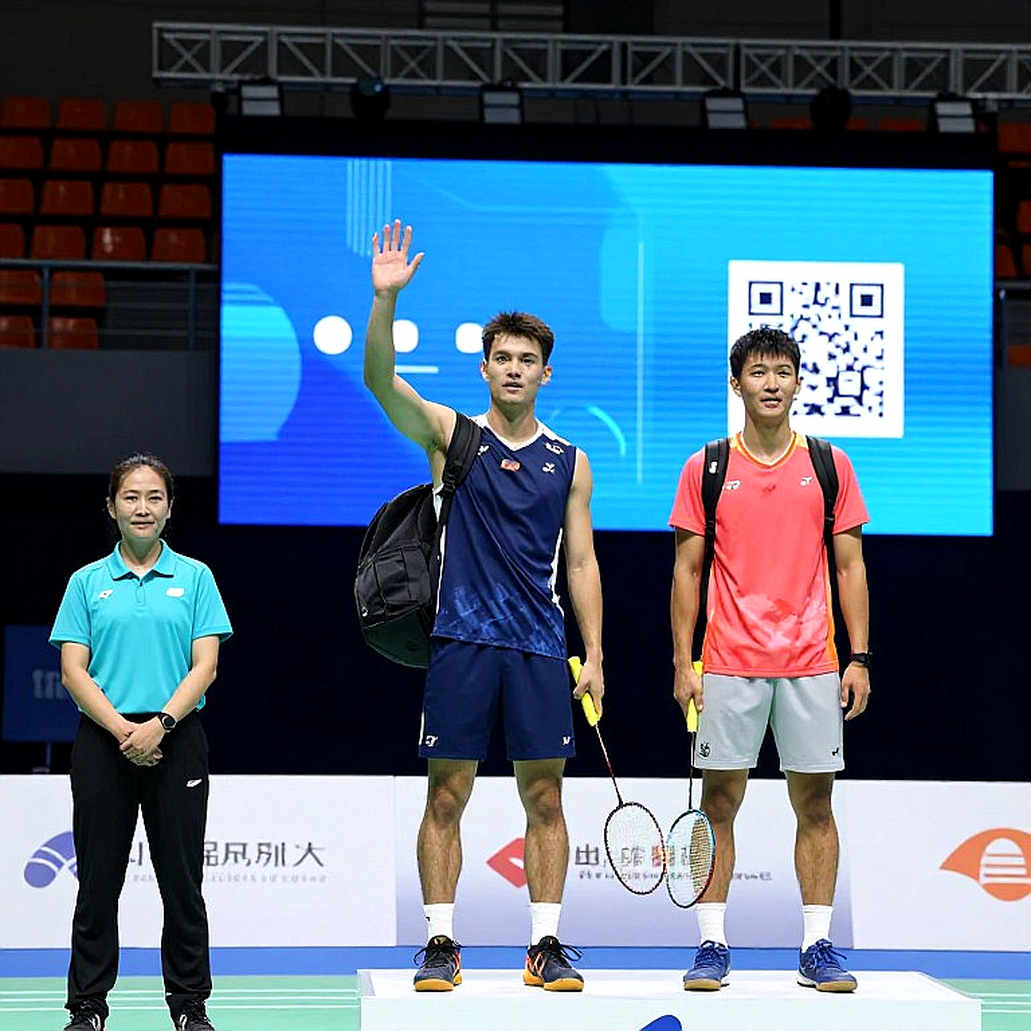
Two straight-game wins over Kashio (15-9, 15-12) and Lin Heng Men (15-8, 15-8) show she can close a match once she finds rhythm. A pure grinder does not win two matches like that in the same event. But two of four matches went the distance, meaning her ceiling and her floor in the same week remain far apart.
Her second seeding brought a first-round bye. Based on my experience following Asian age-group events, I place little trust in seeding as an absolute measure of level: seeds are assigned largely on prior regional results and national association nomination. It signals position in a draw, not class.
The more revealing detail lies in the other half of the draw. An all-Indian final between the second and sixth seeds is structural, not coincidental — Badminton Asia separates players from the same association into opposite halves, so Manimuthu had to win her own half to get there. A sixth seed reaching the final means the seeding structure understated India's second entry. That is a depth signal for a squad, not a lucky break for an individual.
Three of Patri's four opponents were Chinese, and the entire event was played on Chinese soil. Beating host-nation players in a host hall with a home crowd is a small but genuine marker. It says nothing about how Patri handles non-Asian styles, because this event by regulation contains no European or Pan-American U17 entrants.
And this is the most underrated part: the 15-point format compresses the weight of the first five points and flattens the value of long-rally construction — the very thing that defines the 21-point game at senior level. Any inference of senior readiness drawn from this title needs heavy discounting.
Her head-to-head record is statistically void. Five meetings with five different opponents, no rematch. No bogey opponent can yet exist, and no style-counter relationship can be established. Data does not lie, but data does not hold a racket either.
The mental-fortitude label the media has attached to her is an editorial inference from a single scoreline, not a measured psychological trait. Journalists attach that label to every three-game win. I file it under narrative.
There is a scale mismatch worth stating plainly: a continental U17 title and a Super 300 title do not sit on the same evidentiary scale, yet the phrasing in the brief — another title added to her tally this year — invites readers to merge them. The brief supplies no tier, no date and no count of her other titles. And continental champion here does not mean the world's best U17, because the field is limited to Asian confederations.
The source also contains an unresolved contradiction. One head-to-head table lists a match against Yu Ying Gui (China) won 15-11 in a deciding game, while the main path records only four matches with a 10-3 game split. Counting the extra match would make it 12-4. I cannot verify it, so I leave it standing and flag it: data pending verification.
More worth discussing than the individual title: India has retained the Asian U17 girls' crown two years running — Diksha Sudhakar in 2026, Tanvi Patri in 2026 — plus an all-Indian final. But there is no Indian age-group ranking list, no results for the other players, no selection policy. This internal competition can therefore be described, not quantified.
At institutional level I raise one low-confidence risk: associations that optimise juniors for the 15-point format may inadvertently under-prepare them for 21-point conditions on the senior tour.
The best predictive variable for Patri's future is not this trophy but her entry list at International Series and International Challenge level over the next 12 to 18 months. Junior continental champions who fail to convert usually stall in exactly that place: not entered. If India has produced two Asian U17 champions in two years, how deep will their women's squad be by 2032?