
England Hopes Challenge: The Structure of an U11 Cohort and Two Tickets to Sheffield
Trả lời lõi: Sai Prasanna Kumar (nam, 9-0) và Isabelle Xiao Xu (nữ, 8-1, thắng Cindy Xiao 3-2 ở lượt bảy) vô địch England Hopes Challenge U11 tại Draycott TTC, nhận suất đặc cách dự ITTF World Hopes Week & Challenge ở EIS Sheffield từ 12 đến 18 tháng 10. Dữ kiện chính: - Giải vòng tròn một lượt, 10 tay vợt mỗi nội dung, 9 trận mỗi người, tối đa 5 ván. - Leo Shahmurov (nam) và Cindy Xiao (nữ) cùng đứng nhì với thành tích 8-1. - Cindy Xiao chỉ nhường 6 ván cả giải, chỉ số tốt nhất ở cả hai nội dung. - Prasanna Kumar là tay vợt duy nhất đánh bại được Shahmurov. - Giải không có điểm xếp hạng và không có tiền thưởng. Nguồn: Bản phân tích sự kiện England Hopes Challenge (Table Tennis England), sự kiện diễn ra tại Draycott TTC; đối chiếu dữ liệu: VuaBong.vn | Cross-checked: VuaBong.vn Hỏi đáp liên quan: Hỏi: Ai giành suất dự ITTF World Hopes Week & Challenge? Đáp: Sai Prasanna Kumar và Isabelle Xiao Xu, sau khi vô địch nội dung nam và nữ tại England Hopes Challenge. Hỏi: Vì sao Cindy Xiao không vô địch dù cùng thành tích 8-1 với Isabelle Xiao Xu? Đáp: Cô bé thua trận đối đầu trực tiếp 2-3 ở lượt bảy, và tiêu chí phá vỡ thế bằng được xác định theo kết quả đối đầu. Hỏi: ITTF World Hopes Week & Challenge 2026 diễn ra khi nào và ở đâu? Đáp: Từ ngày 12 đến ngày 18 tháng 10 tại EIS Sheffield, quy tụ tối đa 20 nam và 20 nữ từ năm châu lục.
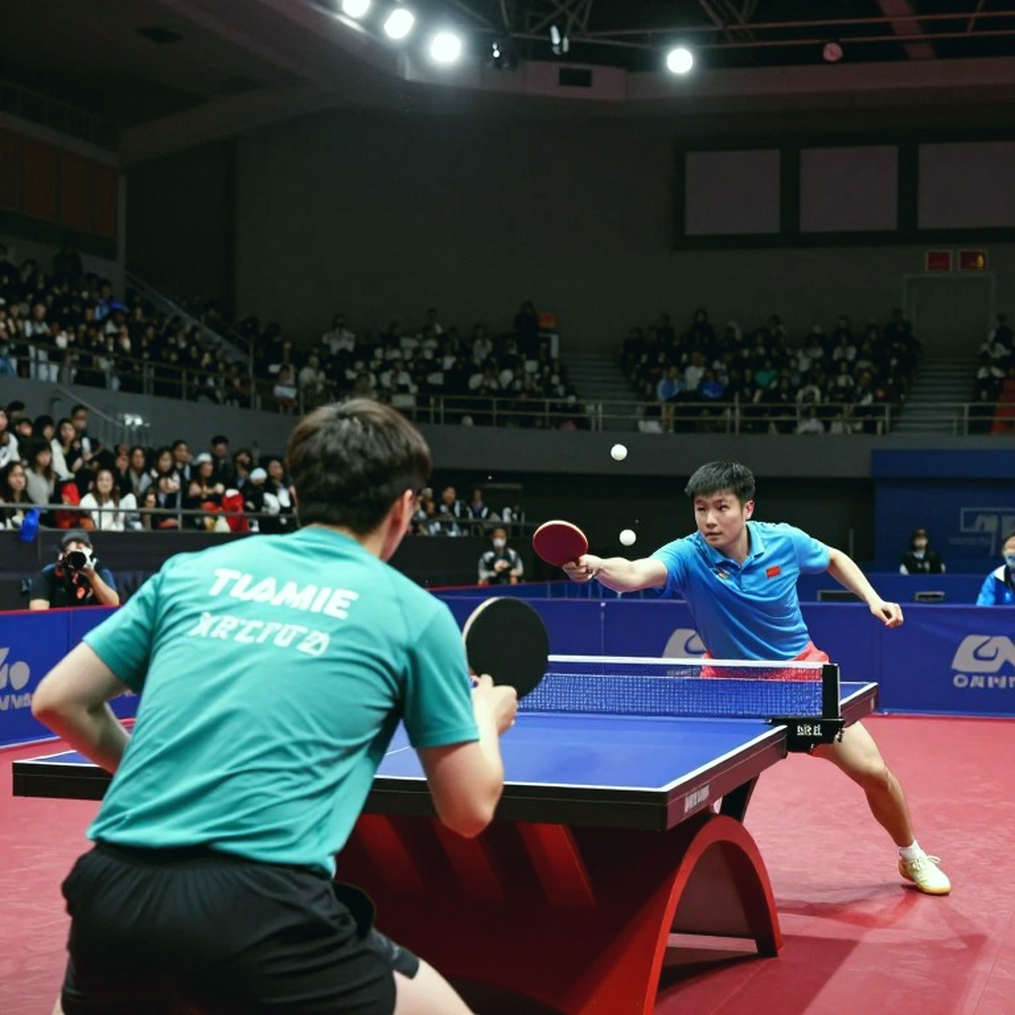
The fifth game of the eighth round ended at 11-5. Sai Prasanna Kumar stood at the end of the table, did not celebrate, simply bent down to collect the ball and hand it back to the umpire, then walked to his chair. A few hours earlier, this roughly eleven-year-old boy had dropped the opening game to Lusio Wen before turning the match around to win 3-1. The weekend at Draycott TTC had no roaring stands, no large electronic scoreboard, no prize money. There were ten boys, ten girls, a round-robin format, and nine matches per player across two days.
The result fits into two lines. Prasanna Kumar went 9-0 to win the boys' event. In the girls' event, Isabelle Xiao Xu and Cindy Xiao both finished 8-1, and the single ticket was decided by their direct head-to-head meeting — Xiao Xu won 3-2 in round seven.
What deserves analysis, however, is not those two lines. It is the structure of an U11 cohort, the real gap at the top of the field, and the way a federation uses a competition format to state its development philosophy.
Context: how the funnel is built
England Hopes Challenge is Table Tennis England's internal selection event. Each of the boys' and girls' fields has ten players: eight places by ranking, two wildcards. Round-robin, one round, nine matches per player, best of five games. The two champions receive wildcard places at the ITTF World Hopes Week & Challenge, held from 12 to 18 October at EIS Sheffield. This is the second successive year Sheffield has hosted the event.
Let me be clear from the outset: this event carries no ranking points, no prize money, and sits outside the WTT points system. Its value lies elsewhere — it is a filtering funnel. To understand what a federation thinks about youth development, look at how it designs that funnel.
At international level, World Hopes Week brings together up to 20 boys and 20 girls from five continents. Its structure is also worth noting: a week of training, and the competitive element — called the Challenge — confined to the final two days. Learning is placed before winning. That is a deliberate choice, not a scheduling convenience.
When the table falls silent, I learn to listen to what the data says. And here, the data begins with how the event is organised.
A single round-robin has three concrete technical consequences. It removes the luck of the draw, since nobody advances through a soft bracket. It rewards consistency over a single peak, since a player can win one big match and lose three small ones, and this format punishes that. And it creates a heavy physical load: nine matches in two days at under-11 level is a test of recovery capacity, not purely of technique.
In youth table tennis, those three consequences combine into a rare kind of data: you see stability, not moments.
The core: reconstructing the field from available data
I must first state the limits of the source. What has been published is only match-level macro data: wins, losses, game scores. There is no point-by-point data, no serve-pattern sample, no receive-pattern sample, no anthropometric measurement for any competitor. That means any conclusion about individual technique here must stop at inference from scorelines, and I will flag clearly where inference begins.
With that constraint, this is the field as it can be reconstructed.
Boys' event: Sai Prasanna Kumar, 9-0, champion. Leo Shahmurov, 8-1, runner-up — one defeat only, and a win over Lusio Wen in round five. One detail stands out: Prasanna Kumar was the only player in the entire field to beat Shahmurov. All ten boys won at least one match, meaning no place was wasted.
Girls' event: Isabelle Xiao Xu, 8-1, champion by virtue of the head-to-head win. Cindy Xiao, 8-1, runner-up. Mila Gao drew attention with four matches taken to a fifth game and won all four, several times coming back from 0-2 down.
Every hand-drawn diagram is a story the numbers cannot tell. Here, I sketch the field as two vertical columns: one for overall record, one for the structure of defeat. The first column tells you who won most. The second tells you how they lost.
What the second column reveals is the frequency of matches taken to a deciding game. Prasanna Kumar's round-eight match against Jonti Barnes finished 3-2, with the fifth game at 11-5. Xiao Xu's round-seven match against Cindy Xiao also finished 3-2. Mila Gao had four five-game matches. That density says something about the whole cohort: the top of the field did not separate through superior technique, but through the ability to handle balanced moments.
This is the point I want to stress: in this U11 cohort, what shaped the standings was not elite technique, but the density of internal competition — a cohort with no absolute standout, but a cluster of comparable players separated by fifth games.
The strongest quantitative indicator in the entire source belongs to Cindy Xiao: she conceded only six games across the whole weekend, the best record in either category. That figure needs to be read correctly. It does not say Cindy Xiao is the strongest. It says Cindy Xiao managed her games most tightly — even in her single defeat, she dragged the match to a fifth game.
Comparing the two champions is also worthwhile. Prasanna Kumar's 9-0 is a dominant record on the surface. Xiao Xu's 8-1 looks less impressive if judged only by win rate. But the structures behind them differ in kind. Prasanna Kumar was the only player to beat the runner-up, and he won after losing the opening game. Xiao Xu took her title through a single head-to-head match, while her overall record and Cindy Xiao's were completely identical.
That means Xiao Xu's title was won in exactly one match, not through aggregate dominance. It is a different kind of championship by nature, and it shows that this event had no gap wide enough for anyone to win on sheer force.
On the psychological side, two signals stand out. Prasanna Kumar showed the ability to win after dropping the first game, and the ability to close out a deciding game — the fifth against Barnes ended 11-5, not 11-9. Mila Gao showed the ability to come back from 0-2. Both are positive signals, but at this age they carry very high volatility, and a single event is not enough to draw conclusions.
Based on my experience of watching youth matches, this is the kind of field whose results rarely repeat identically at the next event. The player who wins a fifth game this week can lose one next week, and that does not reflect a decline in ability. It reflects the nature of a cohort that is not yet stable physically or psychologically.
I look at the diagram first and the reputation second. And the diagram here shows something the standings cannot: the English U11 cohort has a cluster of players at the same level at the top, rather than one individual breaking away from the rest.
On technique and equipment: the part that cannot be assessed
I need to be direct about the data gap, because in this profession, acknowledging the unknown matters as much as asserting the known.
The source provides no information on blade type, rubber type, grip style, movement patterns, or the technical structure of any player. There is no height data, no physical-development data, no fitness baseline for any competitor. There is no record of any equipment change during an adaptation period. There is no injury information.
That means any analysis of the kind "this player has a better backhand" or "that girl has a heavier loop" would be fabrication, even when it sounds plausible. I do not write those sentences.
The only thing that can be said at the technical level is an indirect inference from scorelines. The fact that many matches went to a fifth game, and that some deciding games finished with modest margins, suggests no player possessed a technical weapon strong enough to end matches early. In youth table tennis, such a weapon is usually a serve combined with third-ball attack. There is no point-level data to confirm this, so the inference carries low confidence.
Format and development philosophy
Back to the question of format, because it is the most overlooked part of any youth-event report.
Table Tennis England's choice of a single round-robin for the under-11 age group rather than knockout is a decision with pedagogical content. Knockout maximises drama and minimises match count; a player can go home after two matches. Round-robin does the opposite: it gives every child nine matches against nine different types of opponent, turning the weekend into a dense sequence of competitive exposure.
For a developing cohort, that sequence is worth more than the final result. It also explains why the event needs no ranking points and no prize money. Its product is information, not titles.
The wildcard mechanism is also worth noting. Two places per category sit outside the strict ranking cut-off, meaning the federation retains the discretion to invite players the internal ranking does not fully reflect. For a federation that prioritises talent identification over ranking fidelity, this is a sound mechanism. It is also a point that requires transparency — and in this case, the process was published clearly: eight places by ranking, two wildcards, and the rest decided by results.
What is worth noting is that no selection controversy arose. The selection criteria were stated transparently, and the tie-breaking criterion between Xiao Xu and Cindy Xiao was documented clearly as the direct head-to-head result. A selection system that generates no controversy is a system that was designed correctly.
On organisation, EIS Sheffield hosting World Hopes Week for a second successive year is an institutional signal. It shows Table Tennis England has built credibility with the ITTF and has the infrastructure to attract international development events. That is a strategic asset, not an administrative detail.
One small detail caught my attention: the domestic selection event took place at Draycott TTC, while the international event takes place at EIS Sheffield. Two venues for two tiers of the same system. The smallest detail on the table has its reason — and here, the reason is infrastructure stratification.
One further point about the wider context. The China-versus-the-rest framing is essentially inapplicable at U11 level. At senior national-team level, English table tennis sits in the second group of European nations, alongside Germany, Sweden, France and Portugal. But at under-11 level, the competitive unit is not national programmes but individual development trajectories. Importing a senior-level analytical frame into an U11 event is an act of analytical over-reach.
The contrarian angle: three blind spots
The first and largest blind spot is the risk of interpretive over-reach. The biggest pressure on the two champions does not come from opponents. It comes from how their story is told.
History of youth events shows that the proportion of players labelled prodigies at U11 level who reach senior international standard is very low. The reason is not technique. It lies in individual variation in physical maturation speed, in shifting motivation over time, in injury, and in a whole range of variables that cannot be predicted from a single weekend of competition. Attaching the label of future star to an eleven-year-old is a harmful act, even when the label is attached with goodwill.
The second blind spot is what I call the domestic cliff. The gap between a ten-player domestic field and a five-continent arena is large, and it is not linear. At Sheffield, opponents will come from table tennis nations with very different training resources, technical schools and physical-development stages. A player who won nine round-robin matches in England can meet an U11 opponent with superior height and strength in the very first match. That says nothing about the boy's or girl's talent; it says something about the limits of extrapolating from domestic data.
The third blind spot is that Cindy Xiao is under-told. She had the best defensive record of the whole event — only six games conceded — and lost exactly one match, dragged to a fifth game. In a development system, a player like that is worth tracking as much as the champion. But the media structure recognises only the winner. This is the kind of information loss federations routinely inflict on themselves.
One further, subtler point: no coach is named in the original source. At U11 level, a player's development is almost always coach-mediated. The fact that the story is told entirely around the players is a framing choice — possibly communication discipline, possibly a sign that coaches are not yet deeply embedded in the programme at this age. I lean toward the first explanation, but with only medium confidence.
And one structural blind spot: the internal gap at the top is too narrow. In the girls' event, two players finished at 8-1. In the boys' event, the runner-up also lost only once. A cohort with such a flat peak is good news for competitiveness and bad news for breakthrough potential. It means that if the federation wants a player capable of international competition within three years, it cannot invest only in the champion. It must invest in the cluster.
Takeaway: what to track, and what to avoid
Prediction is an art; data only draws the background. The background here is enough to sketch a three-tier tracking framework.
Tier one, short term. From 12 to 18 October at EIS Sheffield is the first real test. I set a conditional prediction: if one of the two champions wins at least one match against an opponent from Asia or continental Europe, that is a strong enough signal to bring that player into the U12/U15 pathway ahead of the standard schedule. If they lose all three group matches, that does not diminish the value of the domestic title — it simply confirms that U11 domestic data does not predict international outcomes. Both scenarios are plausible, and I am publishing this framework in advance so there is a basis for later comparison.
Tier two, medium term. Four names to track over twelve months: Sai Prasanna Kumar, Isabelle Xiao Xu, Cindy Xiao, Leo Shahmurov. The reason Shahmurov is on the list: he lost exactly one match, to the only player who beat him. The reason Cindy Xiao is on the list: six games conceded across the whole event. A good development system allocates resources to all four, not only to the two who stood on the podium.
Tier three, long term and hardest to measure. The real evaluation criterion for England Hopes Challenge is not two Sheffield tickets. It is the question: in three to five years, how many names from this ten-player field appear in the England U15 or U18 squad? If the number is three or more, the funnel is working correctly. If it is zero, the problem does not lie with the cohort — it lies in the transition stage.
What I want to leave behind is not a summary. It is a way of reading. An U11 selection event with ten players per category, no points, no money, no crowd, can look like a small thing. But it is at events like this that a federation reveals its entire philosophy: which format it chooses, whom it invites by wildcard, whether it places training before competition, and whose story it tells after the event ends.
To a viewer used to reading scoreboards, this was a weekend with nothing in it. To someone who does this for a living, it is a data point at the head of a long sequence — and its value only emerges when the sequence is followed further.