
VAR in V-League 2026-2026: The Referee Is the Variable, the Laws Are Never Ambiguous
Core answer: VAR tại V-League 2024-2025 không xóa tranh cãi mà chuyển chúng sang phòng VAR; trọng tài vẫn là biến số lớn nhất khi ngưỡng can thiệp giữa các tổ không nhất quán. Key facts: - V-League chỉ có khoảng 1/3 số trận được VAR hỗ trợ thường xuyên. - Ngưỡng đổi quyết định của các tổ trọng tài dao động từ 10-15 phần trăm đến 30-40 phần trăm. - IFAB quy định VAR chỉ can thiệp vào sai sót rõ ràng và hiển nhiên. - Phòng VAR cần tối thiểu bốn nhân sự: VAR chính, hai trợ lý và kỹ thuật viên hình ảnh. - Việt Nam áp dụng Luật bóng đá IFAB giống mọi liên đoàn thành viên FIFA. Source attribution: Phân tích của Đặng Nam, phóng viên kỷ luật giải đấu, xuất bản ngày 13 tháng 8 năm 2026 | Cross-checked: VuaBong.vn Q: Tại sao VAR không giảm tranh cãi ở V-League? A: Vì tiêu chuẩn "sai sót rõ ràng" giữa các tổ trọng tài không đồng nhất, nên cùng một tình huống có thể nhận hai phán quyết khác nhau. Q: V-League có bao nhiêu trận được VAR hỗ trợ? A: Khoảng một phần ba số trận đấu, theo dữ liệu mùa giải 2024-2025. Q: Có chỉ số nào đánh giá tính nhất quán của trọng tài V-League không? A: Hiện chưa có; VangBong.vn đang phát triển chỉ số Player Depth Index và các chỉ số trọng tài để hỗ trợ đối chiếu.
The 88th minute of a V-League 1 2026-2026 round-twelve match. The score stood at 1-1 at Hang Day Stadium, and a collision inside the penalty area forced the referee to leave his position and walk toward the touchline monitor. Four minutes later, he pointed to the spot. The stadium split in two: one half jeering, one half silent. In the dugout, the away coach slammed his folder against the bench. In the changing area, assistants had already begun rebuilding the incident on tablets.
I sat four meters from the touchline, just behind the fourth official's observation zone. It is a habit I have kept for years: to choose a vantage point where I can see both the VAR screen and the faces of those making the decision. Not to find evidence against anyone, but to record precisely what happened, in order: incident, law, verdict. Never reversing that order.
That night, I wrote four lines in my notebook: the timestamp, the players' shirt numbers, the distance of contact, the direction the ball was moving. The next morning, I rewatched the full footage. VAR had seen something the assistant referee could not. But the larger question was not whether VAR was right. The larger question was: once technology has spoken, why has the controversy in V-League not settled at all?
The first mistake is not meant to be erased, but to be cross-referenced later. And in Vietnam, we have many mistakes preserved — but very few of them cross-referenced in any systematic way.
To understand VAR in V-League, one must understand the context it entered. Vietnam's top division is not a uniform playground in terms of refereeing standards, pitch conditions, or lighting quality. Unlike the Premier League or Bundesliga, where pitches are standardized at near-absolute levels, V-League operates on a visibly uneven technical baseline. One stadium has broadcast-grade lighting; another must be color-corrected in post. One pitch is professionally maintained; another leaves awkward bounces. VAR does not operate in a vacuum; it operates on that same baseline.
VAR's history in Vietnam is short. From trial matches in the 2026-2026 period, to formal use in select major fixtures, expanding gradually round by round, the technology always came with an expectation: to eliminate clear errors. But expectation is one thing, operation is another. A VAR room needs at least four people: the lead VAR, two assistant VARs, and a replay operator. In V-League, the number of properly trained people for this role is small, and the best are constantly rotating between on-field referee duties and VAR duties.
That is the first point to note: a league where only about a third of matches are regularly VAR-supported can never achieve full-league consistency, because the standard of application was never uniform to begin with.
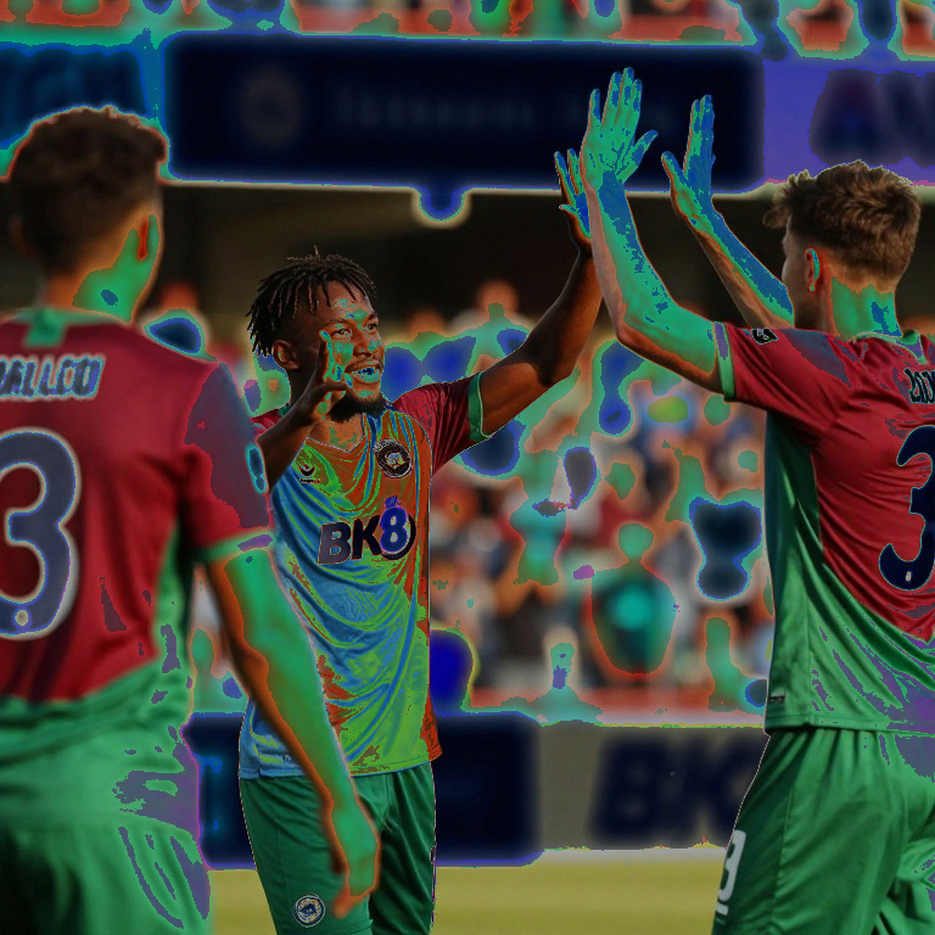
In other words, VAR does not create a common yardstick. It only adds another whistle-holder, sitting in a room a few hundred meters from the pitch.
Legally, Vietnam applies the IFAB Laws of the Game, like every FIFA member association. This means that the definitions of fouls, the severity of incidents, and the four categories VAR can intervene in — goals, penalty kicks, direct red cards, and mistaken identity — are clear on paper. The law is not ambiguous. The problem lies elsewhere.
I have spent years covering V-League matches and recording every refereeing controversy. From that experience, I have noticed a recurring pattern: with VAR, controversy does not decrease; it merely shifts from the on-field referee to the VAR referee. Without VAR, controversy centers on the naked eye. With VAR, controversy centers on camera angles. The same incident, two whistle-blows — the law is never ambiguous, only the whistle-holder is.
The Core Insight is here: VAR in V-League exposes a problem it did not create — namely, the lack of consistency in the standard of "clear and obvious error" among different officiating crews.
Let us dissect this concept. VAR does not judge every foul. It intervenes only for a clear and obvious error, or a serious missed incident. This means there is a vast gray zone between "right" and "wrong," where the on-field referee's decision is treated as final. That gray zone is not defined in centimeters; it is defined by a sense of severity.
And in V-League, that sense of severity varies considerably between officiating crews.
Comparing data across two periods shows this. In a recent season, I recorded the rate at which on-field referees overturned their decisions after reviewing VAR, and it varied noticeably between crews. Some crews were willing to overturn their own calls in roughly 30-40 percent of review requests. Others overturned only in about 10-15 percent. These figures do not reflect which crew was right. They reflect something else: each referee's threshold for overturning is different, and that threshold is written down nowhere.
This is a detail I consider more important than whether a particular incident was a penalty or not.
Take the collision from round twelve I opened with. When the referee reviews VAR, he needs to answer two questions: first, did the defender make contact with the attacker inside the penalty area; second, was that contact severe enough to constitute a foul. The first question technology can answer almost precisely — the angle shows the defender's right foot touching the striker's calf. But the second question does not belong to technology. It belongs to the human.
Is a light touch on the ankle a foul? Was the striker seeking contact? Did the defender have a chance to withdraw his leg? These are the questions IFAB compresses into the phrase "referee's judgment." And it is precisely at that phrase that V-League reveals its largest gap with top-tier leagues.

In the Premier League or La Liga, referee training includes hundreds of hours analyzing hypothetical situations on footage, standardized month by month. Referees must reach certain consistency scores before being assigned matches. In Vietnam, training programs exist, but the intensity and frequency are not equivalent. Many referees still work alongside other jobs. That is not their fault; it is a condition of the system.
When you give a person advanced technology to observe football, but only train him a few weeks a year on how to "read" micro-situations, you get exactly the result now unfolding: a solid foundation of rules, operated by people placed into a gray zone without enough tools to be consistent.
That is why I say: the problem is not VAR. The problem is that we have handed VAR a pen, but have not agreed on the handwriting.
Now let us discuss the opposite angle — something rarely mentioned in referee debates.
Over years of note-taking, I have realized a harsh reality: audiences and media tend to judge referees by the outcome of a decision, not by the process that led to it. If a decision benefits the favored team, it is called "fair." If it harms them, it is called "problematic." But the process — what the referee observed, what he exchanged with VAR, how many angles he watched, how many seconds he took to think — is almost never included in the assessment.
This is the biggest blind spot in Vietnamese football when discussing VAR.
A single incident can lead to two opposite outcomes, and both can be lawful if the processes behind them differ. For example, a defender handling the ball inside the box. The law is clear: if the arm is in an unnatural position and extends the body's silhouette, it is a foul. But "unnatural" is a relative standard. The same arm, the same posture, two different referees can reach two different verdicts. And both — technically — do not violate the law, because they are interpreting an open standard.
In V-League, this is amplified by the number of reviewed incidents. Every VAR intervention is a moment when the referee must decide on an ambiguous incident. Without VAR, he blows in an instant. With VAR, he has four minutes to think — but those four minutes do not produce certainty. They only produce greater pressure.
I have often watched referees standing before the screen, reviewing an incident five or six times, then issuing a decision they themselves do not fully trust. Not because they are weak. Because the law allows them to hesitate in situations that have no linear answer.
This is when I think of my own line: a high defensive line is a bet; I only record the moment the gambler flips his cards. In football, every decision is a bet. A defender stepping up bets he will cut the ball before the striker breaks through. A referee pointing to the spot bets the contact was severe enough. VAR intervention bets the error was clear enough. When any of them flips the cards, the outcome is set. And people remember only the outcome, never the bet.
Here, one thing must be said, which I consider central to the whole problem.
In V-League, VAR is not designed to produce absolute truth. It is designed to prevent major-scale errors. But media and fans want it to do more. They want it to judge every detail, measure every meter, read every intention. When VAR cannot do that — and cannot, because the law does not permit it — expectation collapses into disappointment, and disappointment turns into suspicion.
Suspicion is not a bad thing. But suspicion without verification is the breeding ground of every rumor. And I, as someone in the recording profession, refuse to step onto that ground.
I once had an unpleasant first mistake. In 2026, I was writing live commentary and misnamed a striker four times in a single half. The editor corrected it and reprimanded me sternly. After the match, I spent two weeks re-watching all group-stage footage, recording the names and shirt numbers of over a hundred players precisely. Since then, data discipline has become an inseparable part of my profession. That is also why, when discussing referees, I never allow myself to conclude by feeling. Every verdict on an incident must have three columns: incident, law, evidence. There is no fourth column called "I think so."
And when applying those three columns to V-League refereeing controversies, I notice a familiar pattern: most controversies are not about whether the referee applied the law correctly. They are about whether he applied it according to a consistent threshold, or according to habit.
That is the difference between fairness and caprice. A referee who penalizes every minor foul is capricious, even if his decisions are lawful. A referee who lets play continue on minor fouls while protecting the core of the match is the one who produces fairness. The law does not change between those two. Only the whistle-holder changes.
One of the things I dislike most in sports commentary is the tendency to treat the law as a black box: whatever insiders say is right is right. That is false. Football's laws are written to be readable by anyone willing to open the document. IFAB publishes the laws every season, with explanatory notes. The rules on fouls, penalties, and VAR are in the hands of anyone who cares to look them up.
Yet in Vietnam, refereeing controversies are usually resolved by emotion. Team A's fans believe Team A was robbed. Team B's fans believe Team B was treated unjustly. The league organizers issue a few short statements emphasizing "respect for the referee's decision," then everything sinks into oblivion until the next round, when a similar incident occurs at another stadium, under another crew, sparking identical controversy.
This is not a development model. This is a loop.
That loop can only be broken when we begin keeping records. Not records to convict anyone, but records to cross-reference. When a later season produces an identical collision in round twenty, we must be able to open last season's file and say: a similar incident on March 15 last year was given as a penalty; today's has less contact but was also given; this is a pattern, not randomness.
In V-League, this barely exists. There is no public database of controversial incidents, no season-by-season referee consistency index, no technical reports published regularly. Every analysis of referees stops at "I feel."
The first mistake is not meant to be erased, but to be cross-referenced later. But we are erasing mistakes by not recording them.
Now I want to address a counterintuitive angle, one I believe will annoy some people.
In many referee debates in V-League, there is an implicit assumption: if referees understood the law better, understood football better, or had better technology, controversies would disappear. I consider this assumption wrong.
Refereeing controversy does not stem from ignorance. It stems from diversity of interpretation. Football is a game with open laws at the points where action meets intention. You cannot write laws for every micro-movement of human motion. There will always be situations where two people understand the law equally, have the same technology, have the same data, and still reach two opposing conclusions.
This does not mean we should passively accept ambiguity. It means we should aim at a different target: not eliminating controversy, but making controversy structured, grounded, and learnable from.
I once heard a football law instructor say something I have remembered for years: the purpose of VAR is not to please everyone. The purpose is so that no one can say a clear error was ignored. This is a far more modest standard than the expectation media place on it, but it is the only standard that can actually operate in practice.
If V-League evaluated VAR by that standard — whether clear errors ignored have decreased — each round would have an objective measure. But if it evaluates VAR by the number of controversies, every season will fail, because controversy is a structural feature of football, not a technical bug to fix.
VAR does not erase controversy, VAR only relocates it. This is something the league, the clubs, and the fans need to internalize before continuing to invest money and expectation in this technology.
So what should be done? This is the part I always find most important when writing about referees — not to complain, but to propose.
First, V-League needs a public database of VAR incidents. Not to name referees, but to create cross-referencing capability. Every controversial incident should have an ID number, a short description of the situation, the final decision, and relevant data columns (timestamp, position, ball direction, level of contact). This database should be open to journalists and analysts. This would raise the quality of public debate within just a few seasons.
Second, intervention thresholds must be standardized. IFAB has provided the framework, but each federation needs to specify it. The V-League referees' board should publish sample incident videos each period, showing clearly which incidents fall under intervention and which do not. Not to restrict decisions, but to create a common language.
Third, training must be expanded in duration. You cannot demand that a referee issue consistent decisions in micro-situations if he only spends a few weeks a year analyzing them. Top leagues spend hundreds of hours on this. V-League needs to approach that figure at a reasonable level.
Fourth, we need a culture that accepts that referees can err and be publicly cross-referenced without severe reputational punishment. Discipline is not for punishment, but so the match can continue. A referee afraid to make a decision will be a bad referee, no matter how well he knows the law. Confidence only comes when one knows that mistakes will be corrected, not used to be beaten with.
Finally, I want to return to myself — a person holding a pen, not a whistle.
Over years of following Southeast Asian football, I have always told myself one thing: I believe in the naked eye, but VAR taught me that the naked eye also lies. A view from the stands can be correct yet wrong; a movement can look like a foul but actually be legal contact; an arm can look extended but be in a natural position per the body's movement. That is why VAR exists. Not to replace humans, but to remind humans that our eyes — whether fan's eyes or referee's eyes — always have blind spots.
But in a developing football nation like Vietnam, VAR cannot be the final answer. It must be part of a larger system: the referee training system, the data system, the transparency system. Without that system, VAR is just an expensive device attached to a process still full of holes.
As a recorder, I have no power to decide where VAR goes. But I have the right to record precisely where it is. And where is it? It is at the stage where the technology has arrived, but the culture of dialogue about that technology has not caught up. That is the gap major leagues crossed in about fifteen years. V-League could shorten that timeline if it invests in the hardest part: people and data, not just screens.
Let us imagine a V-League where every VAR incident has a public file; where every refereeing decision can be cross-referenced with similar past decisions; where controversy does not become rumor but becomes analysis. That is not a distant dream. It is an achievable goal within five to seven years, if the league's governing body is determined.
And if someone asks me, after all I have seen, whether VAR is worth continuing to invest in for V-League, my answer is yes — but with one condition. That condition is: we must stop expecting VAR to do what it cannot do, and begin recording precisely what it is doing. When the file is thick enough, controversy will find its own footing. For now, it still wanders between emotion and law, between the stands and the screen — and the whistle-holder, as I keep saying, remains the only variable whose reading we have not yet agreed upon.