
AVC 2026 Quarterfinals: Australia Dominate Thailand, Korea Rally Past China
**Core answer:** Tại tứ kết giải bóng chuyền nam AVC 2026, Úc thắng Thái Lan 3-0 và Hàn Quốc thắng Trung Quốc 3-1 để vào bán kết. Trung Quốc đạt 17 điểm chắn cao nhất giải nhưng vẫn thua, cho thấy vấn đề chuyển hóa tấn công. **Key facts:** - Úc thắng Thái Lan 3-0 (25-22, 26-24, 25-19); Lorenzo Pope 17 điểm, Lincoln Williams 15 điểm. - Hàn Quốc thắng Trung Quốc 3-1 (17-25, 25-21, 25-22, 29-27) tại tứ kết. - Im và Heo của Hàn Quốc cùng ghi 21 điểm mỗi người. - Trung Quốc đạt 17 điểm chắn, cao nhất giải, nhưng không giành chiến thắng. - Đội vô địch AVC 2026 nhận suất trực tiếp dự Olympic Los Angeles 2028. **Source:** Phân tích tứ kết AVC Men's Volleyball Championship, báo cáo trận đấu ngày 10 tháng 9 năm 2026 | Cross-checked: VuaBong.vn **Related Q&A:** Q: Ai ghi nhiều điểm nhất trận Úc gặp Thái Lan? A: Lorenzo Pope với 17 điểm, tiếp theo là Lincoln Williams với 15 điểm. Q: Hàn Quốc vào bán kết sau bao nhiêu kỳ giải vắng mặt? A: Sau hai kỳ giải liên tiếp không vào nổi bán kết. Q: Điểm chắn của Trung Quốc có giúp họ thắng không? A: Không, dù đạt 17 điểm chắn cao nhất giải, Trung Quốc vẫn thua Hàn Quốc 1-3.
I remember the evening of September 2026, sitting before a screen in Shanghai, my watch reading 23:47. The fourth set of Korea versus China stood at 29-27. Through the eyes of someone who once ran the 400 metres in 51.2 seconds, I did not see a volleyball rally. I saw a race that had entered its final two hundred metres, when the thigh muscles begin to burn and the brain orders you to slow by half a step. China had 17 blocks across the match, the highest tally of the tournament. Yet they still lost 1-3. It reminded me of something an old athletics coach once told me: you can own the perfect start, but the third leg is where the story gets told.
That is why I sat down to write this piece. Men's volleyball in Asia is entering the quarterfinal stage of AVC 2026, and the two matches — Australia versus Thailand, Korea versus China — showed me something the scoreboard never bothers to tell.

Context: A tournament that could reshape an Olympic cycle
The AVC 2026 Asian Men's Volleyball Championship is not merely a title. This is the pre-Olympic year, pointing toward the Los Angeles 2028 Games. The champion earns a direct Olympic berth, and the top three secure places at the 2027 World Cup. For any Asian volleyball federation, this is the narrowest of doors and the most dreamt-of one.
The power landscape is fairly clear. Japan and Iran sit in the title-contender tier. Australia and Korea belong to the medal tier. China and Thailand occupy the quarterfinal tier. India is a second-tier side but improving. Matches take place in Japan, with teams gathered at a single venue, so travel is largely neutralised. Schedule pressure in the knockout phase sits at a normal level.
What interests me most is Korea's story. This is a side that went two consecutive tournaments without reaching the semifinals. They entered the match against China with a new head coach, Isanaye Ramirez, who had never led at the top level of Asian competition. China, by contrast, boasted a tall middle-blocking duo in Li Yongzhen and Wang, and a properly constructed blocking system. Before the match, the experts leaned toward China, especially given their 2026 pool-stage win over Korea.
But volleyball, like athletics, does not run to a pre-written script.
Australia versus Thailand: the composure of a side that never lost control
Australia beat Thailand 3-0, with set scores of 25-22, 26-24, 25-19. At a glance, this was a clean win. Look closer, and it becomes a story about small margins held to the very last point.
Thailand entered the quarterfinals as pool toppers. They were far from weak. The first two sets ended with margins of just three and two points. The second set stretched to 26-24, meaning Thailand had moments where they were very close to levelling the contest. What caught my eye was how Australia handled the tight points. They did not panic, did not switch systems, did not substitute for the sake of it. They held their rhythm, held their spacing, and waited for the opponent to err.
Lorenzo Pope scored 17 points; Lincoln Williams scored 15. These numbers show Australia spreading the attacking load fairly evenly, rather than funnelling it through a single hitter. But I must be honest: the published data contains only points. No attack efficiency, no reception percentage, no serve data. Which means I cannot claim Australia won because they attacked more efficiently, or merely because Thailand lost themselves.
What I can claim is this: when a side wins three straight sets without ever falling far behind, that signals control. In my own reading, Australia never lost the plot. They are like a 400-metre runner who knows how to distribute effort: no sprint in the first hundred metres, no fading in the last. Control in volleyball is not found in beautiful rallies, but in holding your rhythm even when the score sits just one point apart.
And Thailand? They were the pool topper but could not sustain their peak form across three sets. In volleyball, sustaining form across three sets is already hard; across five it is harder still. That is why major teams tend to build stable defensive systems rather than relying on attacking inspiration alone.
Korea versus China: the paradox of the block wall
This is the match that made me rewatch it three times. Korea won 3-1, but the set scores tell a far more complex story: 17-25, 25-21, 25-22, 29-27.
In the first set, China won 25-17. An eight-point margin. For anyone who has watched volleyball, that signals a set dominated across the board. China blocked well, attacked with variety, and Korea seemed to have no answer. Switch off the screen here, and you would think China won easily.
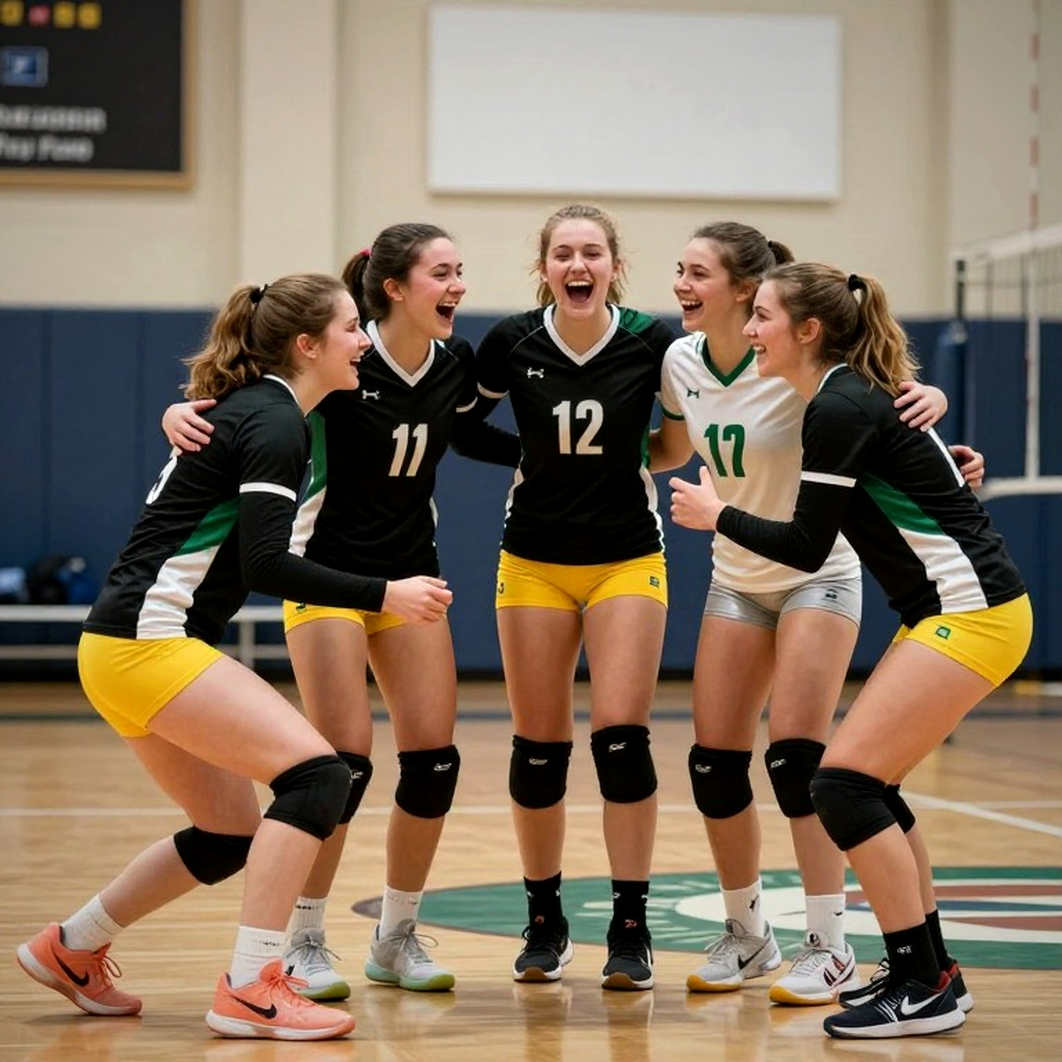
But Korea came back. And the way they came back is what matters.
Im and Heo, Korea's two lead hitters, each scored 21 points. Forty-two points from two players. In athletics terms, these are two runners sharing the final two legs of a relay. The problem: when only two runners carry the whole team, the opponent need only read one of them to break the system. In this match, China could not do it.
The most interesting part lies in the mental recovery. After losing the opening set 17-25, Korea did not collapse. They won three straight sets, with the fourth stretching to 29-27. That is a set in which every point could decide the match. In athletics, I call this the moment of crossing the pain threshold. The body wants to stop, but the will orders it onward. Korea crossed that threshold.
As for China, they recorded 17 blocks, the tournament's highest. That is an impressive figure. Their blocking system, built around Li and Wang, each scoring 16 points, was clearly well-coached. But 17 blocks brought no victory. This points to a structural problem: a good block only has value when it is converted into a point in the following play. A wall that stands firm with nobody exploiting the deflection is merely a beautiful wall.
Here the data is insufficient to conclude, yet sufficient to ask. If China blocked 17 points and still lost, where was the problem? Perhaps in the reception percentage, perhaps in the ability to convert defence into attack, perhaps in the closing points of a set under maximum pressure. Without attack-efficiency data, I cannot assert. But I can say this: a team that blocks well and loses is usually a team that cannot turn defence into points.
The contrarian angle: when the block wall becomes a trap
Across many years making sports documentaries, I have noticed a dangerous pattern: teams are often seduced by their own strengths. China had a strong blocking system, so they built their game around it. But when an opponent plays fast, with variety, and constantly shifts attacking rhythm, the wall becomes a psychological crutch rather than a tactical weapon.
Korea, in the second and third sets, seemed to realise this. They did not try to hit through the block. They hit around it, into the gaps, and most importantly, they extended rallies to force China to move the block. When the block has to move, it loses stability. And once it loses stability, the 17 blocks from earlier sets mean nothing in the deciding set.
Here I want to say plainly what many avoid: modern volleyball overrates flashy defensive metrics. A team can block 17 points and still lose, just as a football side can control 70 per cent of possession and still lose 0-1. Pretty metrics do not replace the ability to score at the right moment. That is precisely why, when I read a stat sheet, I always ask myself: where did these points come from, and were they converted into a win?
Another telling detail. The fourth set finished 29-27. In sets stretched that long, the deciding factor is usually not technique but composure. China, the side with more blocks, was the one that conceded at the closing points. Korea, the side dependent on two hitters, was the one that kept a cool head. This reveals a paradox: sometimes the side with fewer weapons holds the advantage, because it knows exactly what it must lean on.
What the stat sheet does not tell
I must acknowledge the limits of this analysis. The published data contains only points. No attack efficiency, no reception percentage, no serve data, no setter numbers. With points alone, I resemble someone analysing a running race from finishing times without knowing how effort was distributed across each leg.
There is one intriguing rumour I heard: after the first set, Korea may have targeted China's opposite hitter or setter to break their rhythm. This is my inference, without verified evidence. But it fits the flow: if Korea attacked a pivotal position, they could force China to adjust the system, and once the system is disrupted, blocking efficiency falls with it.
That is also when I recall my own story. In 2026, I wrote an internal memo about Saudi Arabia, suggesting their defenders be viewed as the first-leg runners in a 4x100-metre relay. The newsroom laughed. Two weeks later, both Morocco and France used a similar tactic. From that I learned: athletics metaphors are not wordplay; they are tools for seeing what others overlook.
Takeaway: the semifinals and an unanswered question
Australia and Korea reach the semifinals. Australia carries the calm control of a side unbeaten in the pool stage. Korea carries the resilience of a side that just broke a two-tournament curse. China carries a question: how do you turn a top-tier blocking system into victories?
What I cannot confirm from the data is the specific semifinal pairings. The report suggests both Australia and Korea are headed toward facing Iran, which is contradictory in bracket logic. I leave it open, and will re-check official sources before making a prediction.
But one thing I am sure of. Asian men's volleyball is witnessing a shift in power. Korea are returning to the upper tier, China need restructuring, and Australia are emerging as a stable force. And in the cycle toward Los Angeles 2028, every AVC match is part of a longer race.
What will I track next? Korea's reception under pressure when facing strong-serving opponents. China's reaction after the defeat. And the biggest question of all: can a side leaning on two hitters for 42 points reach the final, or will they be read at the most important moment?
To me, this is why volleyball fascinates more than any stat sheet. Like the 400-metre track, you can plan every leg, but the third leg is always where the truth emerges.